Does delivering the best-quality care guarantee great patient outcomes?
Not always. Exceptional care is vital, but patients sometimes require resources outside your scope, specialized expertise, or seamless follow-up. True care quality comes from excellence in the exam room and guiding patients smoothly to their next step.
Which makes one thing clear: strong referral management is non-negotiable.
In the United States, more than one-third of patients are referred to a specialist every year. Yet most practices still struggle to manage these referrals effectively.
Sixty-three percent of primary care physicians and 35% of specialists report dissatisfaction with the current referral system. They cite delays, incomplete information, and poor follow-through as major barriers.
If your referral workflow isn’t streamlined, even the best clinical care can be disrupted, leading to care gaps, frustrated patients, and missed revenue.
Let’s explore why your referral process deserves attention and what your practice can do to make it work smoothly.
Referral management isn’t just about moving patients from one provider to another; it shapes the entire care experience, ensures continuity, and elevates health outcomes. It also plays a major role in protecting and strengthening your practice's financial health.
When referrals flow smoothly, patients reach the right specialist faster, diagnoses aren’t delayed, and treatment plans stay on track. This helps reduce unnecessary ER visits, avoidable complications, and care gaps that often go unnoticed when there is no follow-up on referred patients.
Financially, referral management is one of the most powerful levers a practice can control.
When referrals are poorly coordinated, patients often drift outside your network, a problem known as ‘referral leakage.’ Every leaked referral doesn’t just cost you the immediate visit; it also eliminates all future downstream revenue tied to that patient’s care.
According to an Allied Market Research report, the healthcare system loses an estimated 55–65% of revenue due to referral leakage.
Poorly managed referrals create friction across the care journey. Conversely, when referrals are tracked, standardized, and closed, it strengthens relationships with referring providers, enhances patient satisfaction, and improves practice revenue.
Most traditional referral workflows still rely on manual steps, such as phone calls, faxes, and paper notes. In fact, one study found that 88% of Ontario physicians rely on fax machines to share patient information. These outdated processes slow everything down and create real barriers to care.
In the U.S., nearly one-third (28%) of people reported facing difficulties accessing a specialist for themselves or their families.
Traditional referral processes often break down because of:
In an ideal referral workflow, the quality of the clinical information is equally important as the method.
Too often, specialists receive referrals that miss key details, including recent lab results, diagnostic reports, medical history, progress notes, or even a clear reason for the referral. Without this context, specialists must piece together the patient’s story, which can lead to delays or cancellations.
Once a referral leaves the practice, most providers struggle to monitor its status.
Did the patient consult the specialist?
Was the medical condition addressed?
Without real-time visibility, it becomes difficult to ensure care coordination, and critical issues easily slip through the cracks.
When practices lack real-time insight into specialist availability, patients often end up on long waitlists or are offered only limited scheduling options.
Without a clear view of specialists having open appointment slots, locations offering early appointments, or cases needing prioritization, scheduling becomes challenging. These barriers can easily frustrate patients, and as a result, they often disengage from treatment altogether.
Traditional referral methods lack real-time updates about the referral status. If a patient fails to schedule or follow through, there’s no system to flag it. Long wait times, lack of communication, and confusion about the next steps often force patients to drop treatment or seek care elsewhere, resulting in significant revenue leakage for the practice.
Most patients aren’t familiar with the referral process. When you combine that confusion with long wait times and missing appointment reminders, no-shows become inevitable. Without clear communication and timely follow-up, patients lose track of their appointments, fail to reschedule, and ultimately miss the specialist visit.
Most traditional referral relationships function more like transactions than coordinated partnerships. In many cases, providers don’t personally know the specialists, so communication remains limited.
Specialists may also delay or fail to send consult summaries, leaving PCPs in the dark about the patient’s diagnosis or treatment plan. This breakdown disrupts continuity of care and impacts health outcomes.
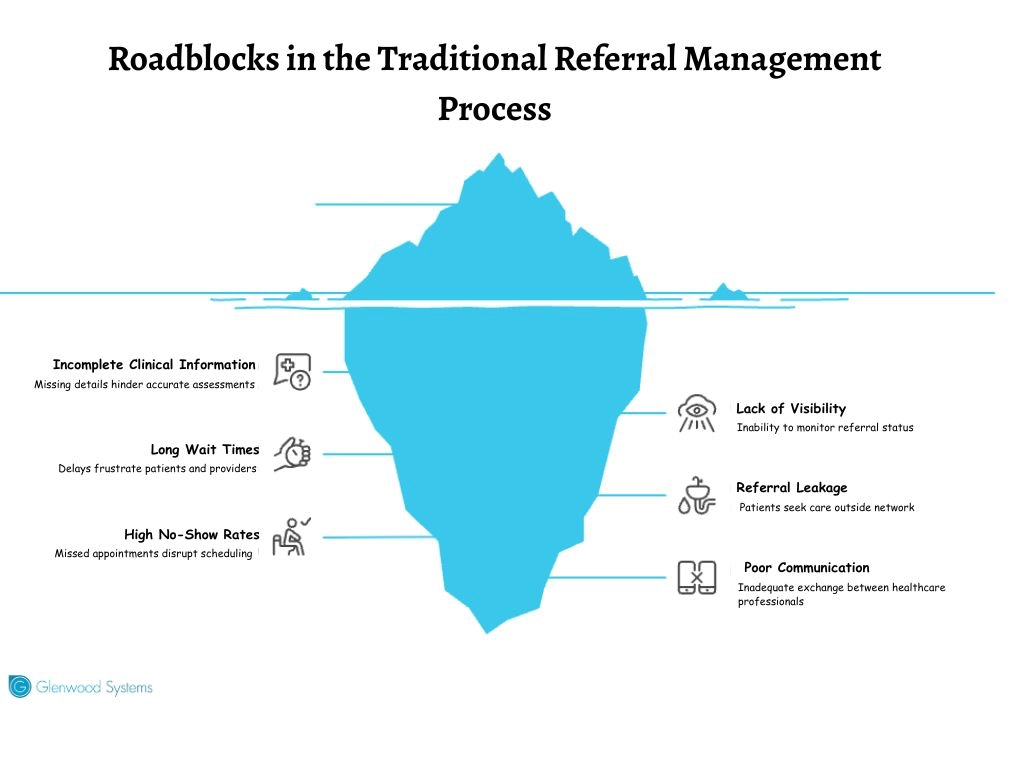
Traditional Referral Management Process
An efficient referral system removes barriers to care, streamlines coordination, and ensures patients move through the care continuum without delays. Here's how it works:
You likely already have the core elements of a referral process in place. Rather than rebuilding it from scratch, the real opportunity lies in expertly refining and elevating what already works.
Here are targeted strategies to strengthen your referral workflow with precision and impact.
The first step in optimizing your referral process is ensuring consistency. When every provider follows unified steps and standardized criteria, referrals become more accurate, faster to process, and easier to track.
A referral agreement between PCPs and specialists helps streamline your referral process, removes the guesswork, and sets clear, shared expectations. This agreement should outline practical guidelines that ensure referrals are complete, appropriate, and easy to act on.
Key elements to include in a referral agreement are:
By clearly defining these standards, your practice stays aligned with specialists, unnecessary referrals are reduced, and patients receive the right care at the right time.
Efficient communication is the backbone of a strong referral process. Every stakeholder, the PCP, referral coordinator, specialist, and the patient, must stay aligned at every step. To make this happen, focus on two critical communication pathways:
Technology plays a crucial role in eliminating the barriers of traditional, manual referral systems. With the right tools, referrals become streamlined, predictable, and far easier to manage for both staff and patients.
Here are a few ways technology elevates your referral workflow:
By integrating technology into your referral management process, you save valuable staff time, reduce errors, and ensure that no part of the referral journey gets lost or overlooked.
Regular audits help you identify inefficiencies, bottlenecks, and gaps in your referral strategy. Instead of viewing these issues as problems, consider them opportunities to refine and strengthen your referral system.
Review key referral management metrics such as:
These insights help you optimize workflows, retrain staff, update referral guidelines, and build stronger partnerships with specialists.
Efficient referral management is a long-term strategy that transforms how your practice delivers care. When referrals flow effortlessly, your practice becomes more predictable, your team becomes more confident, and your patients experience seamless care coordination that sets you apart from competitors.
Patients today expect clarity, convenience, and connected care. A strong referral system makes your practice quite a differentiator. It signals that your practice is proactive and committed to guiding patients beyond the exam room.
Schedule a Free Consultation!


