

Medical claims are more than codes; they’re narratives. Each claim tells the story of how care was delivered, why it was necessary, and what exactly the provider performed.
Modifiers play a crucial role in this story, acting as connectors that bring the story together.
Used correctly, they support clean claims and accurate reimbursement. Used incorrectly, they can lead to delays, denials, and lost revenue.
Let’s look at three of the most common CPT modifier errors and ways to avoid them.
What Are Modifiers?
A CPT or HCPCS code informs the payer about the services delivered. However, medical services often involve nuances that a standalone code cannot convey. Modifiers fill that gap.
Modifiers are two-character numeric or alphanumeric codes added to CPT or HCPCS codes to provide additional information about a service. In simple terms, they answer the follow-up questions the primary code leaves out:
- How was the service performed? (Was it reduced?)
- Why was it done again? (Was it a repeat procedure?)
- Where was it performed? (Was it bilateral?)
- To what extent was the provider involved? (Was it just the professional component?)
They’re only two characters long, but modifiers can determine the fate of a medical claim. Modifier errors account for a significant share of coding denials, which surged 26% in 2025.
The 3 Common Types Of Modifier Errors That Lead To Denials
Although more than 200 modifiers exist, most practices use only 20–30 regularly. Yet errors arise due to complex rules, payer-specific requirements, and NCCI edits.
Most modifier errors fall into three key categories:
- Missing Modifier
- Overuse/ Misuse of a Modifier
- Incorrect/ Mismatch Modifier
Here’s a breakdown.
Missing Modifier
Certain codes should always be reported with a modifier to distinguish components of care, such as professional versus technical services. Without the modifier, payers may view the claim as incomplete or bundled, often resulting in a CO-4 denial.
For example, if a physician interprets a chest X-ray performed at a facility and bills 71045 without modifier 26, it may appear they’re billing for the full service, which can lead to denial.
Overuse/Misuse of Modifier
When modifiers are overused or incorrectly used without clear justification, payers may deny claims, delay payments, or even initiate audits if the pattern continues. Some of the most commonly misused or overused modifiers include:
Modifier 25
CPT modifier 25 is used when an evaluation and management (E/M) service is performed on the same day as a procedure, but is separately identifiable from that procedure.
For example, if a patient presents for the removal of a skin lesion and also requires a separate evaluation for new-onset chest pain, modifier 25 can be appropriately applied.
However, modifier 25 should be used only when:
- The same provider performs both services
- The E/M service is medically necessary
- It goes beyond routine pre- and post-procedure work
- It’s separately identifiable
Sometimes, even when the service is valid, a lack of clear documentation can still work against you. If the notes don’t clearly support a distinct E/M service, payers are likely to question it and deny the claim.
Modifier 59
Modifier 59 is used to indicate that a procedure, other than an E/M service, was distinct and independent from another procedure performed on the same day.
Nevertheless, modifier 59 is applicable only when:
- It applies to procedure-to-procedure NCCI edits
- The services are separate by site, session, organ, incision, lesion, or encounter
- No other specific modifier applies
For example, if a dermatologist removes a lesion on the left arm and also destroys an actinic keratosis on the right leg during the same visit, modifier 59 may be appropriate on the second procedure if the codes would otherwise be bundled.
However, if a patient is evaluated for chest pain and also has a skin lesion removed on the same day, modifier 25 (not 59) is more appropriate.
CMS introduced these modifiers for specific situations.
- XE: Separate encounter
- XP: Separate practitioner
- XS: Separate structure
- XU: Unusual non-overlapping service
However, providers often use modifier 59 instead of these modifiers, which leads to claim denials.
Modifier 50
Modifier 50 is frequently misused due to the confusion surrounding its use. It’s used to report procedures performed on both sides of the body during the same operative session.
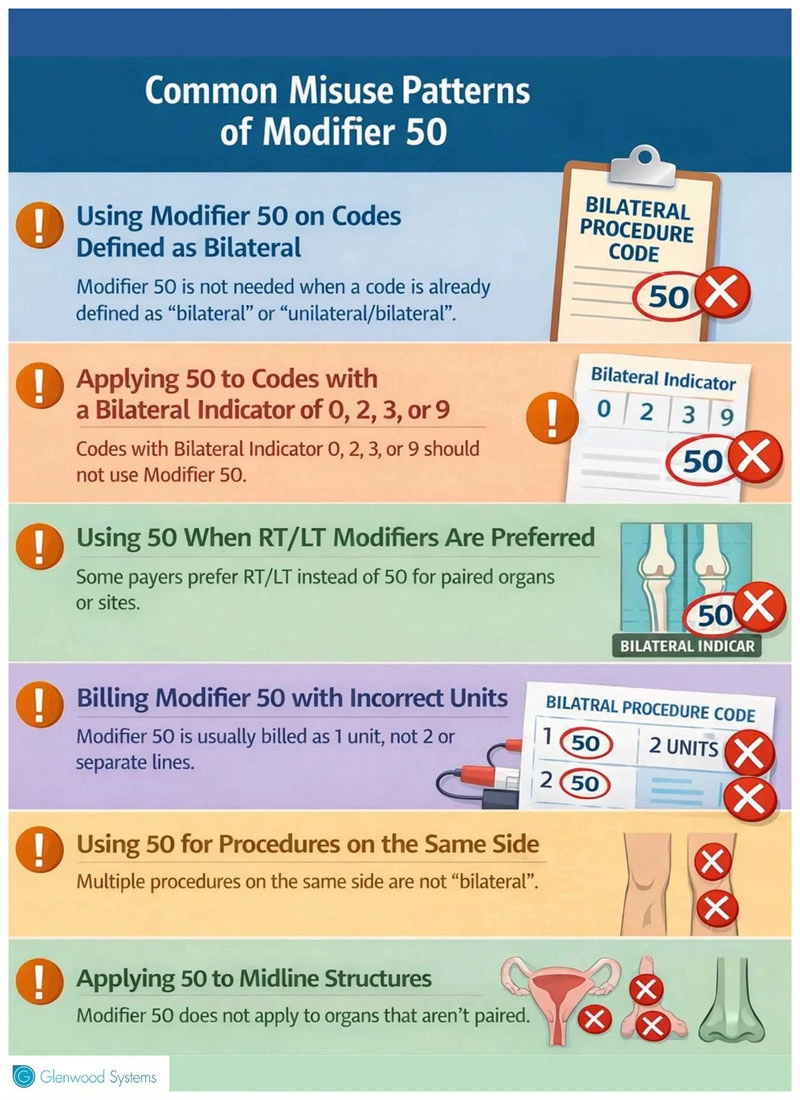
Common misuse patterns of modifier 50 include:
- Using modifier 50 on codes that are already defined as bilateral.
- Appending modifier 50 to codes with a bilateral indicator of 0, 2, 3, or 9.
- Using modifier 50 when the payer requires separate RT/LT line items.
- Billing modifier 50 with incorrect units when the payer requires one line with the modifier 50 and one unit.
- Appending modifier 50 for procedures on the same side of the body.
- Applying modifier 50 to midline organs, such as the bladder, uterus, esophagus, and nasal septum.
Incorrect/Mismatched Modifier
Some modifier errors are straightforward; they’re applied to the wrong type of service or used in situations where they don’t belong.
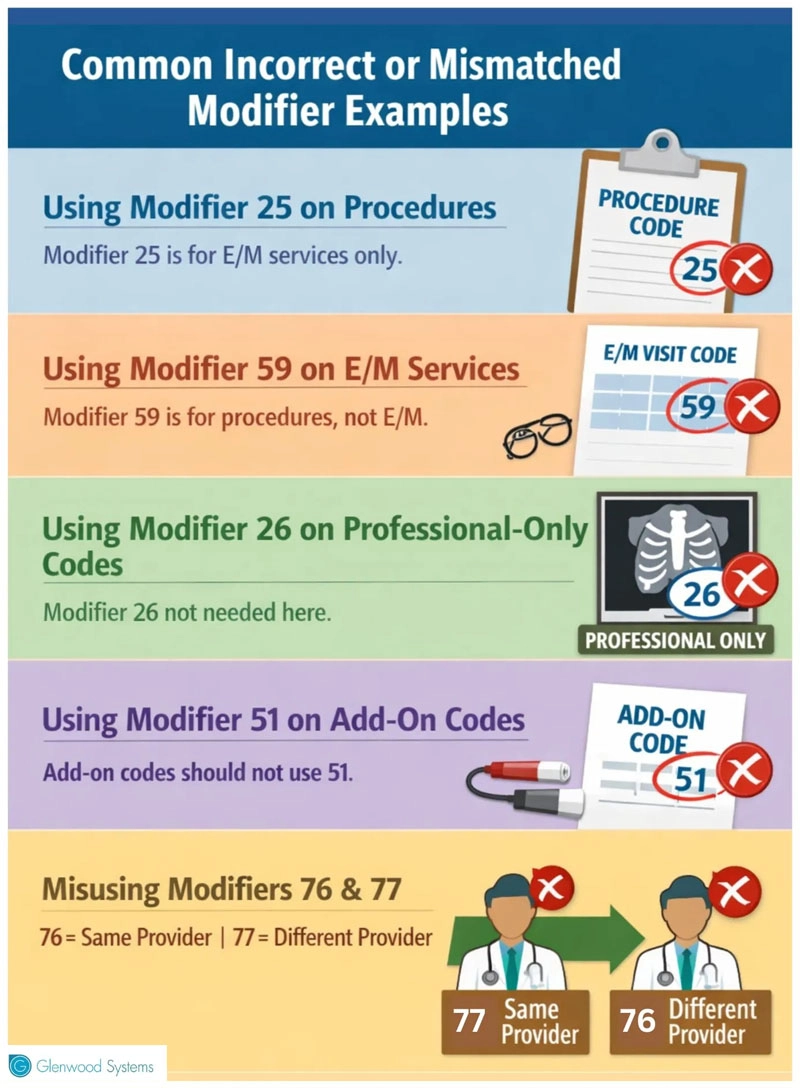
Common incorrect or mismatched modifier examples include:
- Using modifier 25 on procedures instead of E/M services.
- Using modifier 59 on E/M services instead of procedures.
- Using modifier 26 on codes that are already professional-only or not split-billable.
- Using modifier 51 on add-on codes.
- Using modifier 76 when a different provider performed the repeat procedure.
- Using modifier 77 when the same provider performed the repeat procedure.
How To Avoid Errors When Using Modifiers?
Mitigating modifier errors requires regular monitoring, ongoing training, and thoughtful process improvements.
Here are a few practical steps to use modifiers more accurately.
- Audit denials regularly to identify recurring modifier-related errors and address them.
- Train teams on payer-specific rules to ensure compliance.
- Leverage automated coding and AI-driven scrubber tools to catch modifier errors before submission.
- Ensure documentation supports every modifier, especially high-risk modifiers like 25, 50, 59, 76, and 77.
- Maintain payer-specific reference guides to improve coding accuracy.
Modifiers help ensure accurate and optimized reimbursement, but when errors creep in, they can work against you. A small oversight, missing context, or misapplied modifier can change how a payer interprets the entire claim. Clear, accurate claims tell a complete story and guarantee maximum reimbursement.