

Over the decades, healthcare has achieved breakthroughs we once only imagined. We’ve mapped the human genome, shifted from paper charts to digital records, and introduced precision medicine.
Yet despite all this progress, we’re still battling a stubborn, costly reality: Claim Denials.
Yes, many denials are eventually overturned. But by then, the damage is already done.
Revenue gets tied up in claim adjudication. Staff spend hours chasing appeals. Administrative bandwidth disappears. Cash flow slows.
For small and independent practices operating on lean teams and tight margins, the impact cuts deeper. A sudden spike in denials can disrupt payroll planning, stall investment plans, and divert staff from strategic, revenue-generating work.
So what actually caused the most denials in 2025? And how can you mitigate them in 2026 before they snowball into accounts receivable (A/R) problems?
The Reality of Claim Denials Today
Claim denials used to be an occasional headache. Today, they’ve become a measurable threat to healthcare practices, and the data paints a clear picture of how serious the problem has become.
In 2025, 41% of healthcare providers reported that at least one in ten of their claims were denied, up from 38% in 2024 and 30% in 2022.
Moreover, nearly half (48.2 %) of healthcare leaders say denials from commercial payers pose the greatest threat to their revenue cycle.
Fortunately, nearly 90% of claim denials are preventable with the right processes and controls in place. And when they do occur, more than 70% can be successfully overturned when appealed.
But here’s the catch: even “recoverable” denial comes at a cost.
According to Premier, healthcare organizations spent an estimated $25.7 billion contesting denied claims. And that number reflects only the direct financial impact. The indirect costs are just as damaging: staff hours diverted to rework, leadership time spent troubleshooting payer issues, and a slowed cash flow while claims sit in limbo.
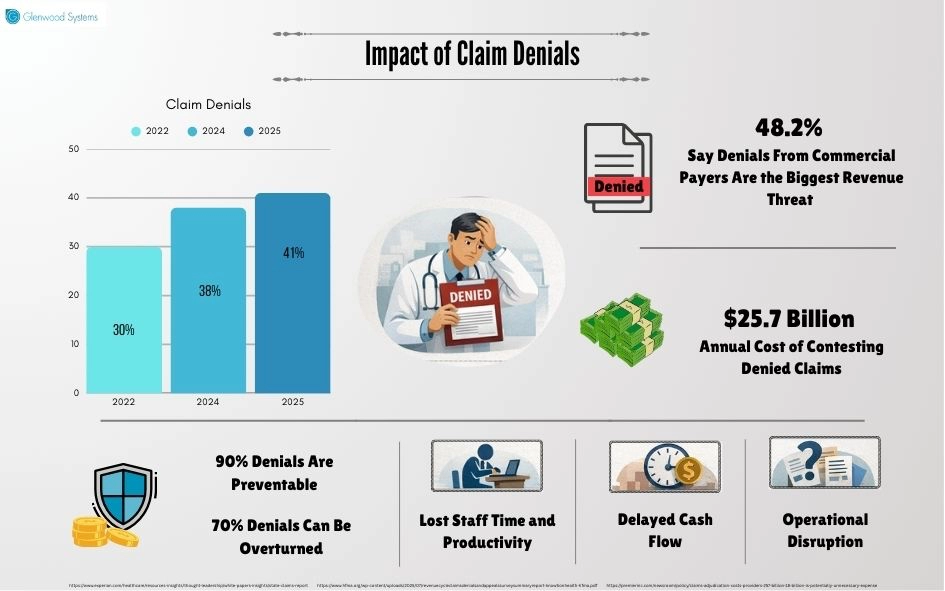
Impact of Claim Denials
The Denials Costing Practices the Most in 2025
Denials aren’t random. They leave fingerprints.
If you want to reduce them, you target the patterns behind them. The real leverage lies in fixing the handful of issues that account for the majority of lost claims.
Let’s break down the most common reasons claims were denied in 2025, and where practices need to tighten their processes.
1. Incorrect or Missing Claims Data
If there’s one mantra that still holds in revenue cycle management, it’s this: clean claims get paid faster.
But keeping claims “clean” isn’t as simple as it used to be. Nearly 7 in 10 providers report that submitting accurate, error-free claims is more challenging today than it was a year ago, largely due to the increasing complexity of payers and stricter edits.
According to the State of Claims report by Experian Health, incomplete or inaccurate claims data ranked as the top reason for denials in 2025. These denials often stem from inaccuracies such as:
- Incorrect or missing policy numbers and member IDs
- Invalid or mismatched provider identifiers (NPI, taxonomy, TIN)
- Incorrect dates and place of service
- Omitted required claim fields
What makes this category especially frustrating is that most of these denials are entirely preventable. They originate upstream, long before the payer reviews medical necessity.
Nevertheless, you can eliminate these errors in 3 easy ways:
- Strengthen Front-End Edits: Configure your practice management system and clearinghouse to create hard stops for missing member IDs, subscriber–patient mismatches, invalid NPIs, incorrect date ranges, and incomplete required fields. Claims should not move forward with foundational data errors.
- Standardize Data Capture: Use structured registration and charge-entry templates with mandatory fields and dropdown menus to mitigate text variation.
- Implement AI-Enabled Claim Scrubbing: Deploy intelligent scrubbers that flag claim errors before submission. Leveraging AI-driven automation reduces errors caused by cognitive overload during peak hours and improves the accuracy of data capture.
2. Prior Authorization Lapses
Prior authorization (PA) breakdowns remain one of the most expensive and operationally disruptive denial drivers.
In 2024, Medicare Advantage insurers fully or partially denied 4.1 million prior authorization requests. That’s not a marginal issue; it’s a systemic pressure point.
Verification has become critical for two major reasons:
- Medicare Advantage enrollment continues to surge. In 2025, more than 34.1 million Americans were enrolled in a Medicare Advantage (MA) plan, accounting for 54% of all Medicare beneficiaries.
- As enrollment rises, so do authorization requests. MA prior authorization requests increased to 53 million in 2024, up from 49.8 million in 2023.
And here’s what makes this even more complex:
- Nearly 99% of Medicare Advantage enrollees are required to obtain prior authorization for at least some services.
- While traditional Medicare requires fewer prior authorization requests overall, a larger percentage (22.9%) of those requests were denied in 2024.
Here are strategies that will help mitigate denials tied to prior authorization compliance failures:
Embed authorization checks into scheduling
Make prior auth verification non-negotiable at two points:
- At scheduling, before the appointment is finalized
- At order entry, tied directly to CPT/HCPCS codes and payer-specific rules
No visit should proceed without a clear prior authorization status: not required, pending, or approved. If approval has been granted, record the authorization number accurately and link it to the scheduled service. This robust workflow design prevents last-minute scrambling and costly retro-authorization attempts.
Track authorization validity and scope
Prior authorization errors occur not only due to missing approvals, but also due to expired or mismatched approvals.
Maintain a centralized authorization log that captures:
- Approved services
- Associated diagnoses
- Date ranges
- Visit or quantity limits
Set automated alerts for expirations, diagnosis mismatches, or service limit overages so staff can correct issues before the patient visit.
Automate with ePA Tools and AI
Replace manual, paper‑based authorization processes with structured electronic prior authorization (ePA) tools integrated with your EHR and practice management system.
Automation reduces reliance on phone calls and faxes, minimizes manual follow-up, and creates stronger audit trails. When implemented effectively, ePA significantly reduces turnaround times, lowers authorization-related denial rates, and improves documentation completeness.
AI simplifies PA further. Advanced AI-enabled systems can:
- Determine whether prior authorization is required based on payer rules
- Pre-populate clinical information directly from EHR
- Translate complex payer policies into structured decision logic
- Predict the likelihood of approval before submission
- Automatically process routine approvals or standard appeals
Over time, machine learning models can also analyze historical denial patterns, identify recurring pain points, and help teams avoid repetitive errors.
3. Incorrect or Missing Patient Information
Nearly 3 in 10 providers report that 10% or more of their denials originate during patient intake and registration. These denials often stem from subscriber–patient mismatches, such as:
- Misspelled patient names
- Incorrect date of birth
- Wrong or incomplete Social Security number
These may seem minor, but even a single incorrect digit in a member ID can trigger an automatic rejection. To mitigate intake-related denials:
- Implement digital check-in tools: Allow patients to enter or confirm their demographic and insurance information electronically before the visit.
- Establish double verification for high-risk fields: Confirm member ID, subscriber details, and plan type against the insurance card every visit.
- Standardize front-desk scripts and training: Ensure staff consistently ask the right verification questions rather than assuming that the existing data is correct.
4. Coding Errors
Coding errors remain a significant contributor to denials, accounting for approximately 24% of claim rejections in 2025. Heightened payer scrutiny and evolving coding edits have narrowed the margin for error, leaving little room for even minor discrepancies.
Common coding-related denial drivers include:
- CPT–ICD-10 mismatches
- Lack of ICD-10 specificity
- Laterality errors
- Incorrect or missing modifiers
- Upcoding or downcoding
Medical coding continues to grow complex, and relying solely on manual processes can delay claim submission and increase errors. Here’s a more effective approach to reducing coding-related denials:
- Invest in specialty-focused coder training: General coding knowledge isn’t always sufficient. Specialty-specific training reduces modifier misuse, improves specificity, and minimizes errors when coding for complex services.
- Align coding with documentation improvement efforts: Foster collaboration between coders and clinicians to ensure medical necessity, level-of-service selection, and specificity are fully supported in the record.
- Leverage automated coding tools: Implement computer-assisted coding (CAC) and AI-enabled validation systems to flag inconsistencies, missing details, and payer-specific conflicts before submission.
- Conduct routine coding audits: Schedule quarterly internal or third-party audits to identify recurring error patterns before payers flag them.
- Create strong feedback loops: Based on the codes most frequently denied, develop concise query templates and provide regular training so documentation and coding are aligned. Leverage these insights and refine your workflows to prevent repeat denials.
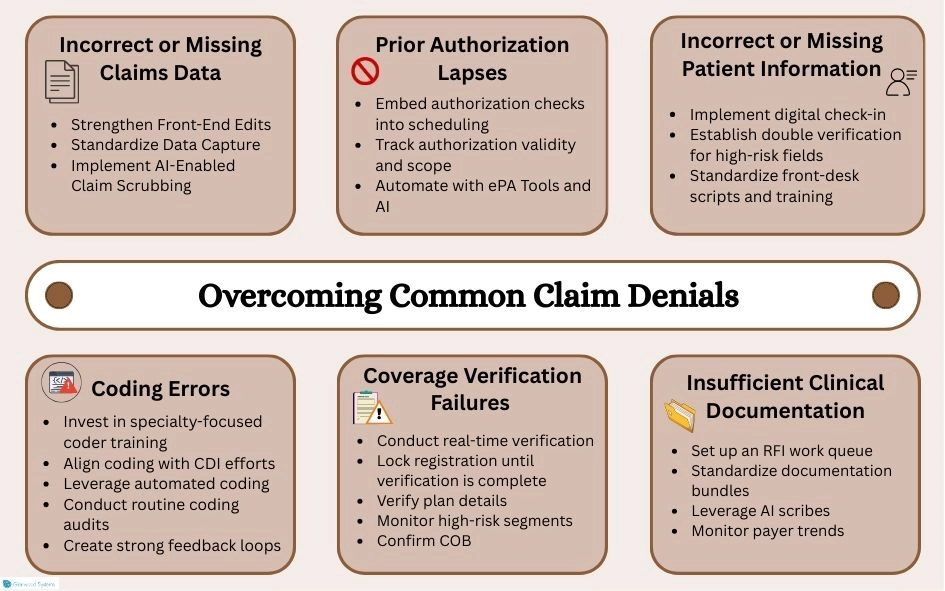
Strategies to Prevent Common Claim Denials
5. Coverage Verification Failures
Insurance verification is a routine step in every patient visit. And yet, coverage-related denials remain one of the most common reasons insurance claims are rejected.
So where’s the real breakdown?
The issue often isn’t that verification isn’t happening; it’s how and when it’s happening.
Coverage can change between the time an appointment is scheduled and the date of service. Employers switch plans. Patients transition to new Medicare Advantage products. Medicaid eligibility fluctuates. Coordination-of-benefits details shift.
If verification is done only once and not rechecked, outdated information slips through. Common root causes for coverage-related denials include:
- Verifying coverage too early and not reconfirming before the visit
- Failing to detect secondary or tertiary insurance changes
- Missing plan-specific coverage limitations
- Failing to identify inactive or terminated policies
- Assuming returning patients’ coverage hasn’t changed
In many cases, the information in the system appears complete, but it’s no longer current. Eligibility is time-sensitive, and even small coverage changes can result in preventable denials. To ensure accuracy:
- Make real-time verification mandatory for every encounter: Run electronic eligibility checks 24–72 hours before the service. Coverage status, plan type, and coordination of benefits can change at any time.
- Lock registration until verification is complete: Configure your practice management system so encounters can’t be checked out or claims generated until patient eligibility is confirmed. Hard stops prevent costly downstream corrections.
- Verify plan details, not just active status: Confirm copays, deductibles, referral requirements, authorization rules, and whether the provider is in-network for that specific product. “Active” coverage doesn’t always mean “covered service.”
- Monitor high-risk payer segments: Track denials by payer and product line, particularly exchange plans, Medicaid managed care, and Medicare Advantage plans where enrollment turnover is higher. Apply enhanced verification protocols to these groups.
- Confirm coordination of benefits (COB): Ensure primary and secondary payer sequencing is accurate and updated regularly to avoid misrouted claims.
6. Insufficient Clinical Documentation
Even when patient information is accurate, prior authorizations are secured, coverage criteria are verified, and codes are correctly assigned, denials can still occur.
Sometimes, it’s a simple mistake: insufficient clinical documentation.
According to the KPI Benchmarking Report from Kodiak Solutions, the initial denial rate tied to “request for information” (RFI) increased to 3.6% in 2025 compared to 3.4% the previous year. The uptick suggests documentation gaps are becoming a more visible trigger for payer scrutiny.
Insurance companies often reject claims upfront due to:
- Lack of supporting documents: The record does not clearly justify the medical necessity or support the level of care billed.
- Missing records or attachments: High-dollar procedures, imaging, DME, or therapy services often require operative notes, treatment plans, or prior authorization proof.
- Lack of specificity: Claims missing laterality, incomplete HPI, undocumented conservative treatment, or vague assessments.
- Incomplete accident or liability details: Insurance claims involving workers’ compensation, auto insurance, or third-party liability require additional documentation before responsibility is determined.
- Unsigned or unauthenticated records: Missing provider signatures or improperly finalized documentation can lead to rejection.
Here are strategies that ensure you get your documentation right the first time:
- Set up an RFI work queue: Track claims with CARC 226/251 denial codes. Assign clear ownership and monitor deadlines to prevent lapses in the appeal process.
- Standardize documentation bundles: For high-risk services (unlisted procedures, surgeries, high-value imaging), standardize attachment sets and submit them upfront as per payer requirements rather than sending records piecemeal.
- Leverage AI scribes: Ambient listening tools such as GlaceScribe help clinicians generate structured, complete, and medically necessary documentation in real-time. AI-assisted notes reduce omissions, improve specificity, and better align documentation with coding requirements.
- Monitor payer trends: Track RFI-related denials by payer and service line. If patterns suggest systematic delays despite high eventual approval rates, escalate internally or address them during contract discussions.
Proactive documentation and smarter tools can significantly reduce avoidable RFIs and prevent revenue leaks.
Reclaim Your Financial Stability in 2026
If 2025 was defined by rising denials, tighter payer scrutiny, and mounting administrative pressure, then 2026 must be the year you take control back.
Glenwood Systems’ advanced revenue cycle management tools are designed to help practices move from reactive denial management to proactive denial prevention. With integrated patient eligibility verification, automated prior authorization workflows, intelligent claim scrubbing, and real-time denial analytics, practices gain visibility into problems before they impact cash flow.
Control isn’t regained by chance. It’s built; one stronger process at a time.