Financial conversations are never easy to bring up, especially in a healthcare setting, where the focus is on healing and compassion. No one looks forward to discussing bills when a patient’s well-being is the priority. But in reality, these conversations are a vital part of delivering transparent care while securing operational efficiency.
Whether you're a physician, practice manager, or front desk staff member, discussing a patient’s financial responsibility can be awkward, delicate, and at times, emotionally charged. Nevertheless, clear, respectful, and proactive payment conversations can improve patient satisfaction and collections. This guide walks you through when to have these conversations and nine best practices to ensure patients feel supported, not overwhelmed.
Nearly half of Americans are struggling with the burden of rising healthcare costs, and 1 in 4 adults report delaying or skipping medical treatment due to affordability concerns. Despite ongoing efforts to expand coverage, an estimated 25 million people remained uninsured in 2023, increasing access barriers to care.
It’s not always the cost that’s the problem; often, the lack of clear, timely financial communication creates barriers. And in healthcare, timing matters. Bring up payment too early, and it can disrupt the care delivery or come across as impersonal. Conversely, if you wait too long, patients can feel caught off guard.
So, how do you strike the right balance?
Every care setting is different, so your approach should be too. Here’s how to handle payment conversations in three common scenarios.
In the emergency room, one thing matters above all else: getting the patient the care they need, fast.
When it comes to financial discussions, the Healthcare Financial Management Association (HFMA) recommends keeping the following guidelines in mind:
In outpatient clinics, physician offices, or hospital departments, you have more flexibility when it comes to payment conversations. In such scenarios, financial discussions can occur at check-in, registration, or discharge, whenever it naturally fits into the flow of care. You can also conduct payment discussions during the medical visit itself, if the patient consents and the conversation does not interfere with their treatment or overall care experience.
An upcoming appointment offers a valuable opportunity to initiate financial discussions before the patient visit. You can have payment discussions at the time of scheduling, whether through a call center or online portal, and can continue via follow-up calls, texts, or emails in the days leading up to the visit.
Patients may also take the initiative to reach out with questions about coverage or expected costs. These moments are valuable opportunities to set clear financial expectations. Proactively addressing these concerns enhances transparency, reduces anxiety, and prevents last-minute confusion, ultimately empowering patients to make informed decisions about their care.
Only one in five Americans has high health insurance literacy, and that lack of understanding has real consequences. Patients often struggle with financial terms such as coverage, deductibles, and out-of-pocket costs, which hinder their ability to make sound decisions. That’s why clear, compassionate financial communication is critical to reducing confusion, building trust, and supporting better health outcomes. Here are 9 best practices every healthcare provider should implement to make patient financial conversations more effective, transparent, and patient-centered.
The nonnegotiable first step in any financial conversation: having accurate information.
When you're discussing what a patient owes, there’s no room for guesswork. Even minor errors, such as misquoting a deductible or overlooking a prior balance, can undermine patient trust and lead to billing delays or disputes. Accuracy is pivotal when engaging in payment discussions.
Before starting the conversation, ensure you've reviewed:
In healthcare, financial decisions often involve more than just the patient, especially in emergencies, critical procedures, or high-cost treatments. In these situations, it’s advisable to involve a spouse, caregiver, or trusted family member in the conversation. Their presence can help the patient feel supported and ensure that decisions are made with clarity and confidence.
Patients may not be familiar with basic health insurance terms, and confusion regarding common terms can make financial conversations feel overwhelming. It’s important to take a moment to explain the essentials and how each one affects their out-of-pocket responsibility.
Regardless of how routine the visit is, every financial discussion should cover these core points:
Moreover, providing a written or digital summary of the information gives patients the chance to review the details at their own pace, helping them feel more confident and less rushed in their decision-making.
Providers often face challenges in patient collections. As patients become responsible for a greater share of healthcare costs, health systems are prioritizing patient balance collections to protect revenue and reduce avoidable write-offs.
Establish clear payment policies from the beginning to avoid confusion and encourage timely payment. Here are simple steps to make your payment policy more accessible and transparent:
Conveying clear payment policies isn’t about demanding payment; it’s about partnership and empowering patients to make informed decisions.
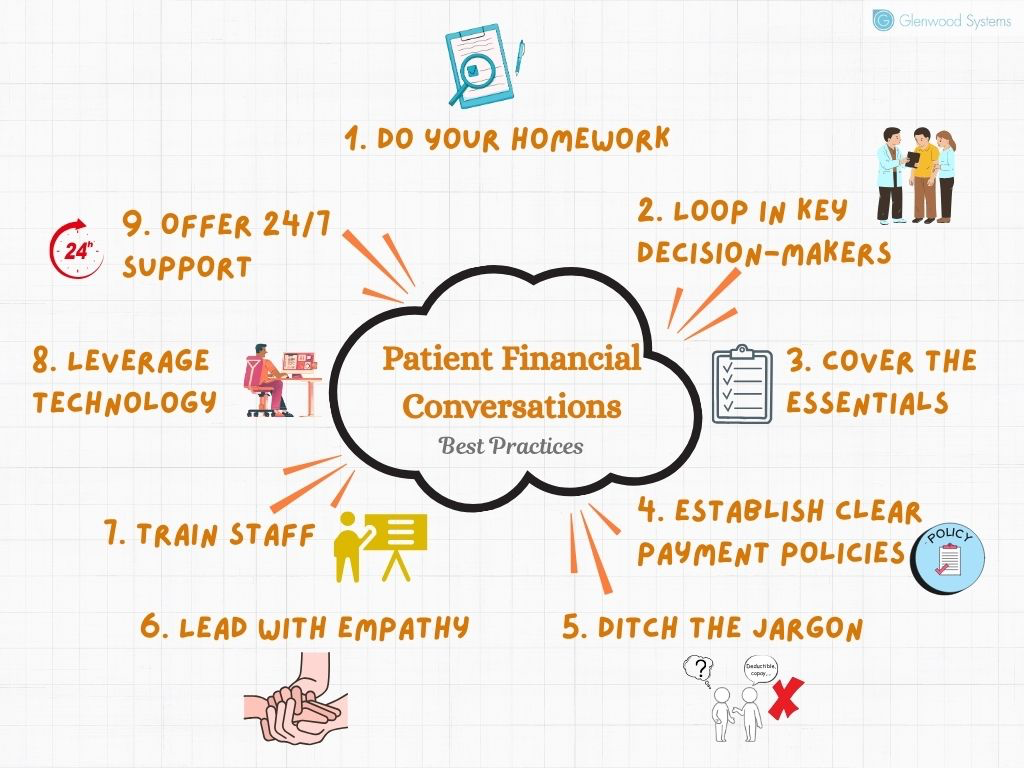
Billing language is often packed with jargon, and for many patients, it’s like speaking a different language entirely. Terms like “deductible,” “coinsurance,” or “contracted rate” can be unclear without context, and may easily confuse or overwhelm patients. And when you're serving a diverse population, including non-native English speakers or those with limited health literacy, language barriers can make financial conversations even more challenging.
The key is to skip the jargon and keep it simple. Use plain, simple language when discussing financial matters to avoid confusion and build trust. Break down complex ideas into simple, relatable concepts, so patients understand their financial responsibilities.
Managing a health condition is stressful enough; the last thing patients want to stress about is the bill. What makes it worse? Being on the receiving end of a poorly handled financial conversation. In such moments, patients aren’t just dealing with numbers; they're dealing with fear, uncertainty, and stress. Approaching a payment conversation with empathy and respect can turn a challenging moment into a meaningful connection.
A compassionate approach can convert a difficult conversation into a supportive one. Acknowledge the concerns. Ask how they’re feeling. Offer solutions, not ultimatums. A little understanding goes a long way. When patients feel heard and supported, they’re far more likely to engage in a conversation that leads to resolution rather than resistance.
Not every staff member is naturally comfortable talking about costs, and that’s okay. Communication is a skill that anyone can master with the right training. Investing in staff training directly improves revenue collection and patient experience.
Ensure your team is confident and well-equipped to handle financial conversations by providing regular training on:
You can also develop templates or scripts to make financial conversations more consistent and less stressful for staff. These ready-to-use scripts empower your team to approach sensitive topics with clarity, confidence, and compassion.
Manual processes often struggle to keep pace with high-volume or repetitive work, especially when financial tasks accumulate or require quick turnaround. Technology helps automate routine financial tasks and simplify complex workflows.
Use these tech tools to elevate your financial communications:
Billing questions don’t follow a 9-to-5 schedule, and neither should your support. Today, patients expect convenience, flexibility, and quick answers. Meeting patient expectations enhances their overall experience.
Leverage AI-powered tools, for example, intelligent chatbots and virtual assistants, to offer 24/7 support. These advanced tools can handle common billing inquiries such as explaining charges and co-pays, checking payment status, and collecting payments, without overwhelming your front desk staff. They can also be integrated with your billing systems to provide real-time answers based on the patient’s account, creating a more personalized and seamless experience.
Navigating patient payment conversations doesn’t have to be daunting. At its heart, healthcare is about people. When you approach financial discussions with clarity, empathy, and genuine partnership, you can transform awkward money talks into opportunities to build trust and support patients on their care journey.
Schedule a Free Consultation!


