Are the constant headlines about healthcare system closures leaving you feeling overwhelmed? You're not alone, and your concerns are valid.
According to the Center for Healthcare Quality and Payment Reform (CHQPR), more than 768 rural hospitals in the U.S. are at risk of shutting down. Shrinking reimbursements, rising overhead, and staffing shortages are pushing many healthcare systems to the brink of collapse.
Yet, there’s a glimmer of hope amid the turbulence. A recent report by McKinsey & Company projects the provider EBITDA to grow at a compound annual rate of 8%, reaching $385 billion by 2028. Hospitals might negotiate higher reimbursement rates during upcoming contract renewals, signaling that improved margins are achievable.
You may not have the size or leverage of large health systems, but you can take control by tightening operations, leveraging data, and optimizing every step of your revenue cycle. Let's walk you through actionable, margin-boosting strategies that make you future-ready.
Clinical effectiveness and financial stability go hand in hand; both are key indicators of your practice’s overall operational performance. Any gaps in efficiency, whether operational, administrative, or clinical, will inevitably be reflected in your bottom line.
Periodic KPI audits help identify bottlenecks, inefficiencies, and areas underperforming within your practice. Here’s how each KPI offers insights into different aspects of your operations:
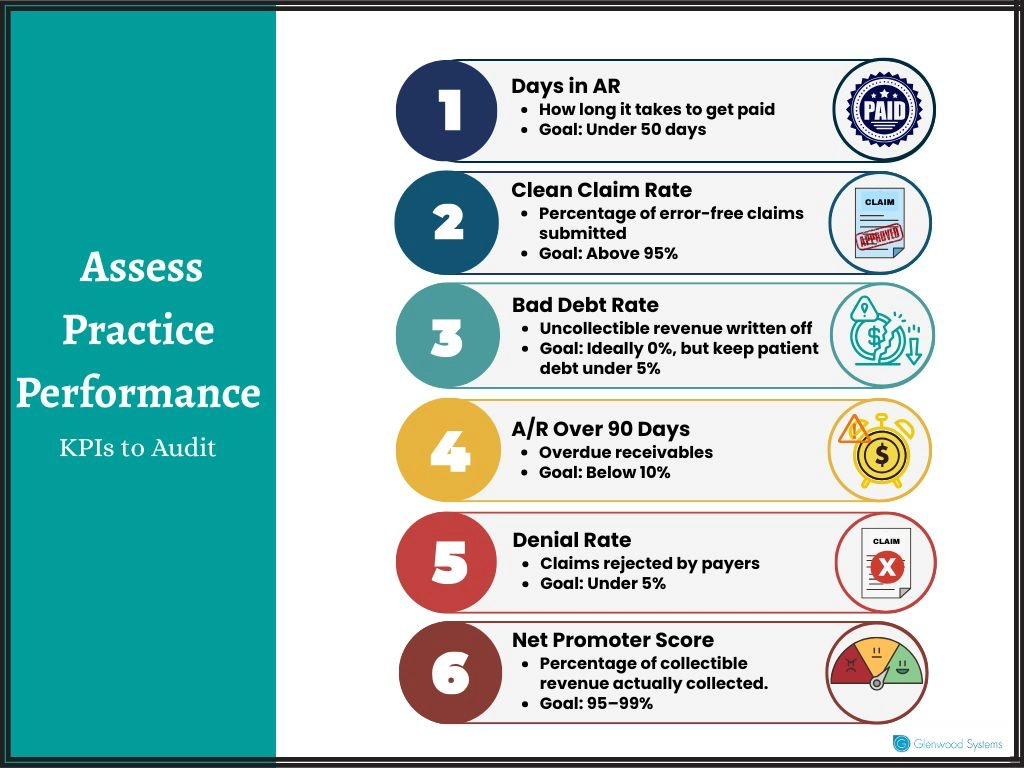
KPIs that Reflect Practice Performance
Proactive evaluation of key performance metrics safeguards your practice from costly revenue leaks and helps seal widening margin gaps. Leverage these valuable insights to optimize operations and boost financial performance.
You wouldn’t rush to diagnose a patient without a thorough evaluation; the same applies to your practice expenses. Not all spending cuts are wise, nor are all expenditures essential.
A recent Kaufman Hall report highlights that labor expenses per calendar day increased by 4% from January 2024 to January 2025. However, non-labor costs surged further, with supply expenses rising 7%, drug costs rising 6%, and overall non-labor expenses rising 6% year over year. The numbers speak for themselves: staffing, medical supplies, equipment, and IT systems remain the primary cost drivers.
Of all the major cost drivers, we often overlook supply utilization and inventory management. Yet, they can significantly impact your margins if left unchecked. So, you must first reassess your procurement patterns. Excess inventory ties up working capital and increases the likelihood of waste, especially with perishable or expiring items.
Conversely, insufficient stock can hinder clinical efficiency and force urgent, costly purchases. To mitigate these risks, revise your continuity plans, adopt decentralized inventory frameworks, and diversify sourcing channels to enhance resilience. Most importantly, incorporate AI-powered, data-driven tools to forecast demand, optimize order timing, and automate supply management.
Are your staffing ratios appropriately resourced? With workforce shortages tightening their grip across the healthcare industry, striking the right balance between competitive wages and optimal staffing levels is imperative to retain skilled employees and prevent burnout or turnover, which are far more costly in the long run.
When it comes to equipment and IT infrastructure, it’s crucial to evaluate whether your investments are delivering meaningful returns. Practice management tools are integral to alleviating administrative burdens, so making informed, strategic choices in this area is essential.
Outdated or underutilized medical devices and legacy software platforms drive up maintenance expenses and hinder efficiency and staff productivity. Regularly audit your technology stack and vendor contracts; you may be incurring unnecessary costs for redundant, obsolete, or underperforming tools that no longer align with your clinical or operational goals.
Do you think your packed schedule guarantees a healthy bottom line? Not quite.
Your payer mix significantly impacts your profit margins. Increasing patient volume won’t help if the reimbursement rates don’t keep up. Understanding what your payer contracts say is key to protecting your profits.
Begin by segmenting your revenue by payer type: commercial insurance, Medicare, Medicaid, and self-pay.
Then, dig deeper. Evaluate the average reimbursement per visit, per procedure, and patient for each payer. Often, practices discover that a significant portion of their patient panel is enrolled in lower-paying plans, which can quietly erode margins, even when schedules are full.
Once you've adequate data, use it to:
Equally important is the ongoing review of payer contracts. Reimbursement rate adjustments, coding changes, or subtle shifts in terms can significantly impact your bottom line. Routinely review contracts for updates and monitor reimbursement trends, denial rates, and payer-specific bottlenecks.
RVUs help you assess provider productivity in a standardized way. It's like a productivity scorecard that quantifies the effort, time, and complexity of each service, allowing you to compare performance across your team. Monitoring provider RVUs helps identify gaps and determine which providers are generating more value. For example, if one provider consistently generates higher RVUs, you can explore what’s driving that difference: patient panel mix, documentation quality, or clinical efficiency?
Tracking RVUs by provider and comparing them against industry benchmarks can guide more informed decision-making. Leverage this data to align the right types of visits with the right providers, balance workloads efficiently, and maximize the revenue potential of every appointment slot. Moreover, analyze whether your highest-RVU-generating services are underutilized.
Patient throughput is another vital metric that directly impacts both patient satisfaction and your bottom line. It refers to how efficiently patients move through your practice, from check-in to check-out. While it may sound like a simple flow issue, it often reflects core operational strengths or gaps.
Patient satisfaction surveys often expose hidden friction points in your workflow, from check-in to check-out. These surveys often reveal what your team may miss:
The truth is that patients tend to notice inefficiencies more than they applaud what works well. Long waits, rushed consultations, or disorganized transitions between departments leave a negative impression. Act on the feedback and reengineer your workflows. Simple adjustments, such as online scheduling, digital check-ins, or real-time alerts, streamline patient flow and enable greater patient capacity per day without compromising quality.
Many independent practices operate in a state of survival, with providers wearing far too many hats. Unfortunately, when clinicians spend more time on routine administrative tasks, they miss revenue opportunities and risk burnout.
Highly trained clinicians often spend hours on routine responsibilities: patient intake, follow-up calls, and prior authorizations. These are critical tasks, but they don’t require a physician’s expertise. Delegating them to medical assistants, nurses, or care coordinators improves efficiency and protects valuable provider time for patient care.
Financial workflows need attention, too. Assign billing, collections, and denial resolution to a dedicated revenue cycle management (RCM) team. When billing responsibilities are fragmented or left to clinical staff, denials increase, reimbursements are delayed, and your bottom line suffers.
Furthermore, technology can reduce your team's administrative burden. Robotic Process Automation (RPA) and AI-powered tools help reduce administrative fatigue while significantly boosting operational efficiency. These technologies handle time-consuming tasks such as claims status checks, insurance verifications, appointment reminders, and even clinical documentation through ambient scribing.
Take GlaceScribe, for instance, Glenwood’s AI scribe that listens to provider-patient conversations and automatically generates structured SOAP notes. It even suggests CPT codes based on clinical context, streamlining both documentation and coding. Automation empowers your team to spend less time on data entry and more time on patient care and strategic tasks that directly impact your bottom line, improving both patient outcomes and profit margins.
The profit margin game isn’t about cutting corners; it’s about making every effort, every dollar, and every resource count. Start small, stay consistent, and refine your approach continuously because even minor improvements can lead to significant gains in your bottom line.
Schedule a Free Consultation!


