Rising patient volumes can mask financial problems.
McKinsey reports that healthcare EBITDA fell from 11.2% in 2019 to 8.9% in 2024, with margins expected to decline further to 8.7% by 2027. Meanwhile, regulatory changes might increase the number of uninsured patients and the risk of uncompensated care.
Amid this volatility, an unbalanced payer mix tightens cash flow, limits investment opportunities, and threatens sustainability.
Join us as we examine the risks of a payer mix imbalance and strategies to build a more resilient revenue foundation.
Payer mix refers to the proportion of a provider’s total revenue that comes from various payment sources, including commercial (private) insurance, government programs such as Medicare and Medicaid, self-pay patients, and other third-party payers.
The payer mix is calculated by dividing the revenue generated from each payer category by the total revenue, then multiplying by 100.
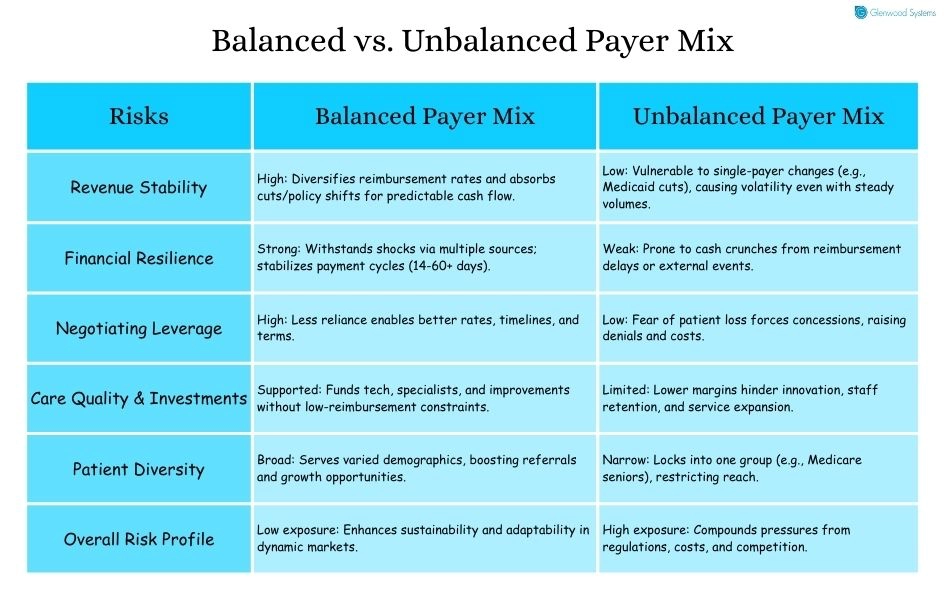
Payer mix directly impacts practice finances. When revenue skews toward a single payer, you become more vulnerable to reimbursement cuts, policy changes, and enrollment shifts.
An unbalanced payer mix exposes practices to the following financial risks:
Commercial plans generally provide the highest reimbursement, followed by Medicare. If your revenue primarily comes from a single payer, particularly lower-paying or tightly regulated programs, small regulatory shifts can destabilize cash flow and complicate financial planning.
Varying payer reimbursement timelines can further strain cash flow. While Medicare typically pays within 30 days, commercial payers may take 30–60 days or longer. A balanced payer mix reduces reimbursement volatility and prevents operational disruptions.
A skewed payer mix limits your ability to challenge unfavorable contract terms. The risk of losing a substantial number of patients often outweighs the benefits of negotiating better contract terms.
An optimal payer mix enables you to negotiate rate increases, secure value-based incentives, improve payment timelines, and reduce administrative complexity.
High concentration of federal government payers with lower reimbursement rates can limit your ability to invest in advanced diagnostic technologies, attract and retain skilled specialists, expand clinical services, and sustain continuous quality improvement efforts.
Payer types are often associated with distinct patient demographics. For example, Medicare primarily serves older adults, while commercial insurance typically covers working-age individuals and their families.
Overreliance on any single payer group can limit service offerings, geographic reach, referral growth, and expansion opportunities.
Here are 5 practical strategies to optimize your payer mix and restore economic stability.
The first step is to understand the revenue distribution. Analyze each payer's revenue contribution and profitability rather than focusing solely on patient volume.
Track KPIs such as net revenue, margin, denial rates, and AR days by payer to identify early shifts before they translate into margin erosion.
Also monitor risk indicators, including:
Different service lines attract distinct payer profiles, making service expansion a practical way to reduce dependence on any single payer category. Offering extended clinic hours, same-day appointments, and seamless digital access attracts a more diverse payer mix. Simultaneously, strengthening referral networks, optimizing site-of-care strategies, and services such as telehealth and remote monitoring expand reach, allowing your practice to diversify care.
Payer contract negotiation is the most powerful lever that strengthens financial performance when backed by data-driven positioning and a clear articulation of organizational value.
Demonstrate your value to the payer by highlighting:
Next, ground your negotiations on comparative data, including industry benchmarks and regional market rates to support proposed rate adjustments and challenge underperforming contracts.
Beyond reimbursement, also address operational and administrative challenges, such as:
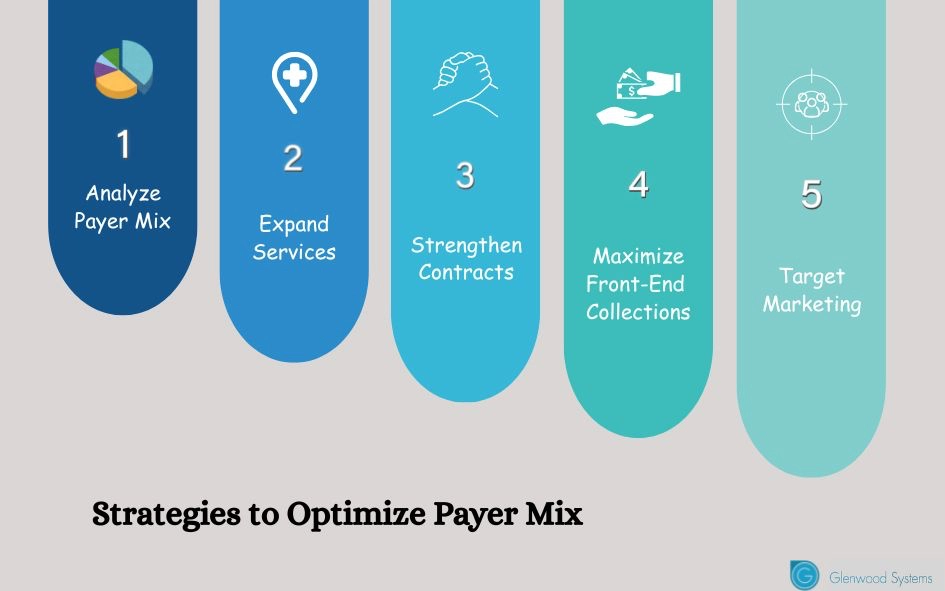
Effective eligibility verification, clear communication about patient responsibility, and front-end collections maximize revenue capture. Offering flexible payment plans and easy-to-use digital payment options further streamlines patient collections.
Use demographic, geographic, and employer data to tailor marketing initiatives that attract commercially insured individuals through digital channels and service offerings.
Strengthen referral networks to drive volume to high-value service lines. Targeted marketing supports payer mix diversification, lowers patient acquisition costs, and promotes sustainable revenue growth.
An unbalanced payer mix rarely creates immediate disruption, but over time, it erodes your finances. A balanced payer mix gives you the financial freedom to invest, adapt, and lead, regardless of shifts in the healthcare landscape.
Schedule a Free Consultation!


