Is your practice getting paid right the first time? For 7 in 10 providers, first-pass accuracy is harder than ever.
The real obstacle is the increasing complexity of eligibility rules, authorization requirements, documentation standards, and payer edits.
The fallout is significant: rising denial volumes, longer A/R days, and a cash flow crunch. While appeals may recover revenue, you've lost time and resources.
Overturning denials begins with understanding their origin and how to prevent them. Join us as we uncover denial risks and their solutions at every stage of the revenue cycle.
Efficient appeals can resolve claim denials, but that shouldn’t be your primary strategy. The goal is to prevent denials.
Nearly one in five in-network claims were denied in 2024, with 7% tied to coverage and 9% to prior authorization issues. These signal operational breakdowns, not clinical disputes.
The key to preventing them is identifying breakdowns and fixing them at the source. Here's how:
Nearly half of claim denials are linked to registration or verification errors.
Below are the most common front-end errors that lead to denials, and strategies to address them.
1. Eligibility and Coverage Errors
Eligibility issues often arise when checks are not done in real-time. A minor oversight can lead to denials.
Moreover, manual verification is a time-intensive task, with teams spending hours toggling between payer portals and reviewing plan benefits.
How to fix it:
2. Registration and Demographic Errors
Registration errors occur due to discrepancies in patient information, such as incorrect DOB, ID number, or plan details, which can trigger immediate rejections or denials.
How to fix it:
3. Lack of Authorization
Authorization denials stem from missed or invalid prior authorizations and overlooked payer requirements, especially for imaging, procedures, and specialty care.
Getting this step right is critical, as nearly all Medicare Advantage plans require prior authorization for at least some services.
How to fix it:

Most mid-cycle denials stem from two primary issues: documentation gaps and coding errors. Let’s look at each.
Documentation Errors
Insufficient clinical documentation is the primary reason for denials. In 2024, 5% of denials were tied to medical necessity, underscoring the need for improved documentation standards.
How to fix them:
Coding Errors
As coding regulations and payer rules change, errors such as incorrect codes or modifier usage, upcoding, and downcoding are driving mid-cycle denials.
How to fix them:
The back end serves as the final checkpoint before claims are submitted and is critical in recovering denied revenue. Its effectiveness depends on two key functions: claim submission and denial management.
Claim Submission
Before submission, each claim is scrubbed and validated. Common denial reasons at this stage include:
How to fix them:
Denial Management
Denials may be inevitable, but their impact depends on how effectively they are managed.
Most teams work on denials reactively, without prioritization, automation, or visibility into which appeals are most likely to succeed.
How to fix it:
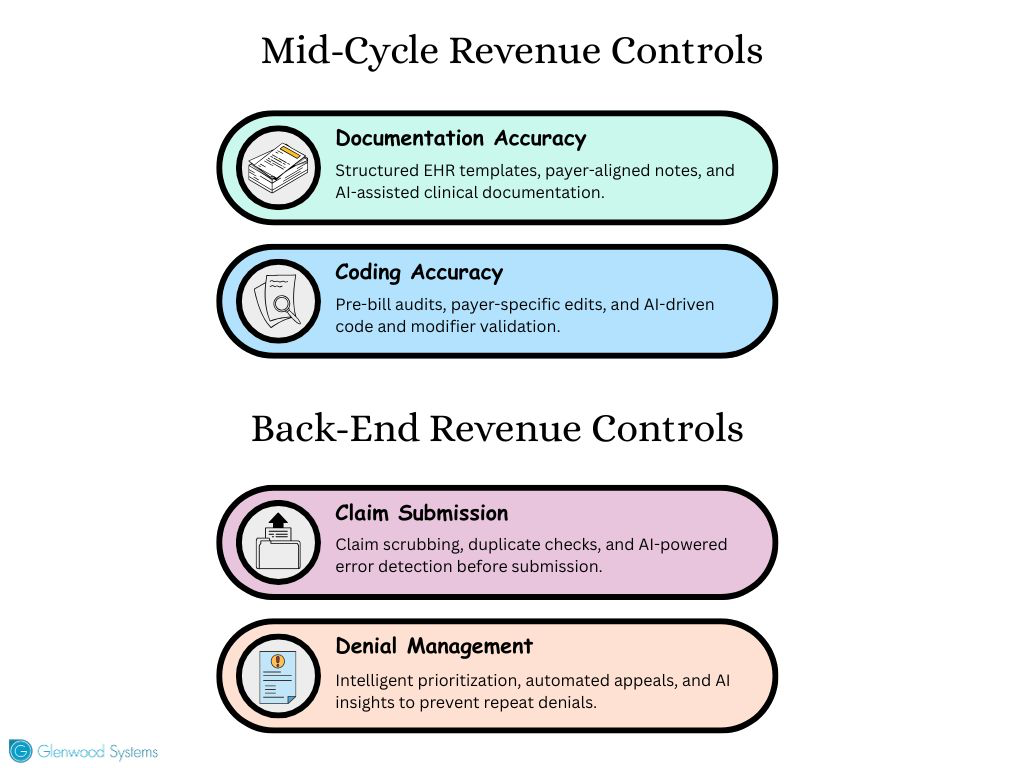
Reducing denials requires control across the entire revenue cycle. Glenwood helps you achieve this with intelligent automation, AI-driven insights, and integrated workflows.
At the front end, GlaceRCM automates insurance verification, eligibility checks, and patient collections. During the mid-cycle, GlaceEMR and GlaceScribe support accurate and compliant documentation that reduces coding- and documentation-related denials. On the back end, GlaceRCM streamlines claim submission, denial management, and A/R follow-up, with intelligent RCM dashboards.
Together, Glenwood’s solutions help prevent denials, streamline billing operations, and ensure 99%+ collection rates.
Take control now, before denials dictate your revenue.
Schedule a Free Consultation!


