

Private practices and healthcare organizations continually strive to secure full reimbursement while navigating claim denials, underpayments, and heightened payer scrutiny. These challenges directly affect revenue and demand ongoing attention.
However, there’s another equally critical pressure point: rising overhead costs.
Today, the average medical practice spends 60–70% of its revenue on overhead, leaving little room for profit and growth. With inflation, staffing shortages, and global disruptions driving costs even higher, many practices face mounting financial strain.
Where does your practice stand?
Are your overhead costs optimized, or eroding your profitability?
In this blog, we’ll break down what medical practice overhead costs include, the current cost pressures shaping the healthcare industry, and practical strategies to reduce expenses while building long-term financial stability.
What Are Medical Practice Overhead Costs?
Running a medical practice, like any business, involves a range of ongoing expenses. Overhead costs are the total expenses required to keep a practice running smoothly, excluding the direct cost of patient care. They typically include:
- Staff salaries and benefits
- Rent or lease payments
- Medical supplies and equipment
- Insurance premiums (malpractice, liability, cybersecurity, and health coverage)
- Billing, administrative, and IT expenses
- Marketing expenses
In reality, most of these costs are highly variable and influenced by factors such as inflation, labor market trends, and supply chain volatility.
When overhead costs climb too high, they erode your profit margins. If your practice spends 70–80% of its revenue on operating expenses, it’s a clear sign that profitability is under pressure and that, over time, this can undermine long-term financial stability.
On the other hand, maintaining overhead around 50–60% of revenue is generally more sustainable, though the ideal benchmark varies by specialty and by how expenses are calculated.
The Cost Squeeze in Healthcare: Current State and Emerging Pressures
Healthcare practices today face rising costs across multiple fronts. According to the MGMA, 90% of medical groups report rising operating costs, with an average increase of about 11% in 2025 alone.
Labor costs remain the largest driver. Growing patient demand, combined with a shrinking workforce, is driving up salaries and increasing reliance on temporary staff.
At the same time, inflation, tariffs, and trade disruptions are raising the cost of medical supplies, equipment, and vendor services, with many of these increases passed through as price hikes and surcharges.
Geopolitical instability, particularly tensions in the Middle East, is contributing to energy-market volatility and higher fuel costs. Together, these factors are steadily driving up overhead costs and mounting financial pressure on practices.
As cost pressures continue to rise, reactive cost-cutting fails to deliver sustainable results. Practices that strive for excellence should adopt a structured approach that improves efficiency and strengthens long-term financial stability.
Strategies to Reduce Overhead Costs and Build a Financially Resilient Practice
Managing overhead costs is like trimming a plant; you want to cut just enough to support healthy growth, but overdo it, and you risk weakening the entire system. The same applies to cost-cutting in healthcare. Without the right approach, what looks like a saving today often turns into a bigger expense tomorrow.
Effective cost management is not a blanket cut; it depends on a clear understanding of how your practice operates, where money is spent, what’s necessary, and what’s not delivering value. Without that clarity, cost-cutting efforts often fail to deliver results.
Here’s a simple 3-step framework to help you manage your overhead costs:
Assess→ Reduce→ Optimize
Assess: Identify where your spending isn’t delivering value
Reduce: Eliminate unnecessary and excess costs
Optimize: Improve efficiency without increasing costs
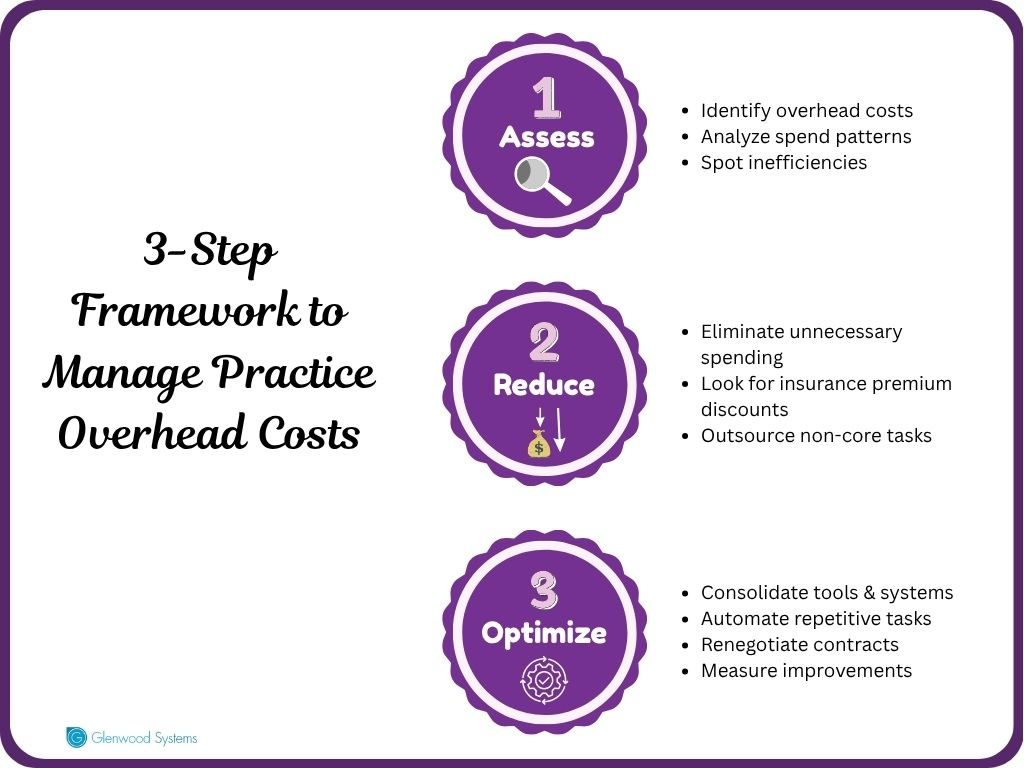
1. Assess
First, evaluate your practice operations. A detailed analysis helps uncover inefficiencies that often go unnoticed yet significantly affect your overhead costs.
A good place to start is to ask:
- What’s driving your overhead costs?
- Which expenses are fixed, and which are variable?
- Are staffing costs aligned with patient volume, provider productivity, and demand?
- Are you paying for unused, duplicate, or low-value software, subscriptions, or services?
- Is your inventory appropriately stocked, or are you overstocking and tying up cash?
It’s also important to link spending to outcomes. Not every cost is bad; some drive growth, improve the patient experience, or increase efficiency. The goal is to distinguish between necessary costs that support operations and growth and non-essential costs that add little or no value.
Let’s take a simple example. Investing in a reliable practice management or RCM system may seem like a high upfront cost, but it can reduce claim denials, speed up reimbursements, and lower administrative workload.
On the other hand, many practices continue paying for software subscriptions or features they rarely use, or for tools that no longer justify their cost. These expenses add to overhead without delivering meaningful value.
2. Reduce
Now that you’ve identified what’s essential and what isn’t, the next step is to eliminate unnecessary costs. This step is critical. The focus isn’t on broad cost-cutting; it’s about eliminating wasteful expenses while preserving care quality and operational performance.
Here are some key areas to focus on:
Staffing
Practice managers should ensure staffing levels align with patient volume, provider productivity, and visit demand. Overstaffing, especially in administrative roles, can inflate overhead without improving outcomes. Conversely, understaffing can lead to burnout and inefficiencies. Therefore, maintaining an optimal workforce is imperative.
AI and automation now handle many repetitive administrative tasks, such as eligibility checks, claim scrubbing, and appointment reminders. Leveraging these tools can reduce manual workload and optimize labor costs without compromising efficiency.
Insurance Premiums
Insurance is essential; you can’t eliminate it, but you can manage it more strategically by negotiating discounts. For example, providers who belong to professional or specialty associations may qualify for malpractice premium discounts, depending on the carrier and program. New practitioners and recent graduates may also be eligible for introductory rates. In addition, some insurers offer premium credits for completing risk management or continuing education programs.
Review business insurance policies regularly to ensure the practice isn’t paying for overlapping or unnecessary coverage. Bundling policies with the same insurer can sometimes lower total premiums and reduce administrative complexity.
Subscriptions and Technology
A wide range of tools streamline practice management, from scheduling to billing and reporting. Over time, practices often accumulate multiple tools that serve similar purposes or are underused. These redundancies increase overhead without improving efficiency.
To address this, focus on rationalizing your technology stack:
- Eliminate unused or rarely used subscriptions that add to overhead without delivering value.
- Remove duplicate or overlapping software that serves the same function. Standardize tools to reduce costs and operational complexity.
- Downgrade premium plans if advanced features are not actively used or do not contribute to efficiency or outcomes.
- Consolidate platforms wherever possible to reduce licensing costs, maintenance effort, and integration overhead.
Inventory Management
Inventory is another area where overhead costs can escalate without immediate visibility. If you’ve been overstocking and experiencing ongoing waste, it’s time to redesign your inventory management approach. Maintain optimal stock levels based on usage patterns and demand forecasts to reduce waste and avoid unnecessary costs.
Marketing Spend
Not all marketing efforts deliver equal value. Some channels consistently generate strong returns, while others quietly drain your budget without meaningfully driving patient acquisition.
Focus on identifying which channels are actually driving results. If a campaign consistently underperforms or is inactive, scale it back or discontinue it.
Redirect that spend toward strategies with measurable impact, such as channels that improve patient acquisition, retention, or engagement.
Where possible:
- Prioritize campaigns with clear ROI and trackable outcomes
- Shift toward data-driven digital channels that provide better visibility into performance
- Regularly reallocate budget based on what’s working, not on what’s been used historically
3. Optimize
You’ve identified where you’re overspending and taken steps to reduce unnecessary costs. But stopping there can create new problems: inefficiencies, workflow gaps, or even reduced productivity.
Optimization focuses on getting more value from what you already have. Instead of adding new resources, the goal is to improve your current systems, staff, and workflow performance.
The following approaches help improve efficiency without increasing costs:
- Cross-train Staff: A flexible team can handle multiple responsibilities. This reduces reliance on additional hires and ensures workflow continuity during staff shortages, absences, or peak demand.
- Streamline Workflows: Heavily reliance on manual effort increases time and cost, even when headcount remains the same. Leverage AI and automation to handle repetitive processes such as scheduling, documentation, coding support, billing, and payment collections.
- Consolidate Tools and Platforms: Using multiple disconnected systems increases cost and complexity. Consolidating tools into integrated platforms improves efficiency, reduces duplication, and lowers overhead.
- Group Purchasing and Shared Services: Leverage group purchasing opportunities to lower costs without compromising quality. Group purchasing organizations (GPOs), association discounts, and shared-service arrangements help you access better pricing on supplies, insurance, technology, and business services. Pooling demand with other providers improves negotiating power and reduces per-unit costs.
- Outsource Strategically: Maintaining everything in-house is resource-intensive and requires dedicated staff. Smaller practices, in particular, can benefit from outsourcing revenue cycle management, often at a lower cost and with better efficiency. Tools like GlaceRCM and GlaceEMR streamline practice operations and improve revenue performance without adding to administrative burden.
- Optimize Contracts and Agreements: Operational efficiency also depends on the terms you work with. Renegotiating vendor contracts, lease agreements, and payer reimbursements helps improve margins. Even small adjustments can have a significant financial impact over time.
Track the impact of every optimization effort using clear operational and financial metrics to ensure they deliver the intended results.
Managing Costs Today, Securing Stability Tomorrow
Sustainable cost management ultimately comes down to balance: controlling expenses without compromising care quality, staff performance, or the patient experience. Practices that consistently align spending with value protect their margins and create room for growth, innovation, and better patient outcomes.
Having the right partner can make all the difference. Glenwood Systems has helped practices reduce administrative burden, streamline operations, and improve revenue cycle performance. Our aim is to provide an efficient, focused practice where providers can spend less time on operational challenges and more on patient care.
With the right support in place, managing costs becomes less about constant firefighting and more about building a stable, scalable foundation for the future.