Your schedule’s packed, patient volume is solid, and your clinical team is firing on all cylinders. On paper, your practice finances should be thriving. After all, high patient volume is supposed to translate into strong financial performance. Isn't it?
But while the doors are busy, the dollars just aren’t showing up.
So what’s the disconnect? More often than not, it comes down to revenue slipping through the cracks, quietly and consistently, due to workflow inefficiencies, billing missteps, or outdated processes.
It’s not always obvious. Maybe it’s a few missed charges here, a delayed claim there, or overhead creeping up over time. Alone, these issues seem minor, but together they can put real pressure on your bottom line.
Fortunately, once you identify the leaks, you can tighten things up with improved systems, streamlined processes, and clearer visibility into your numbers.
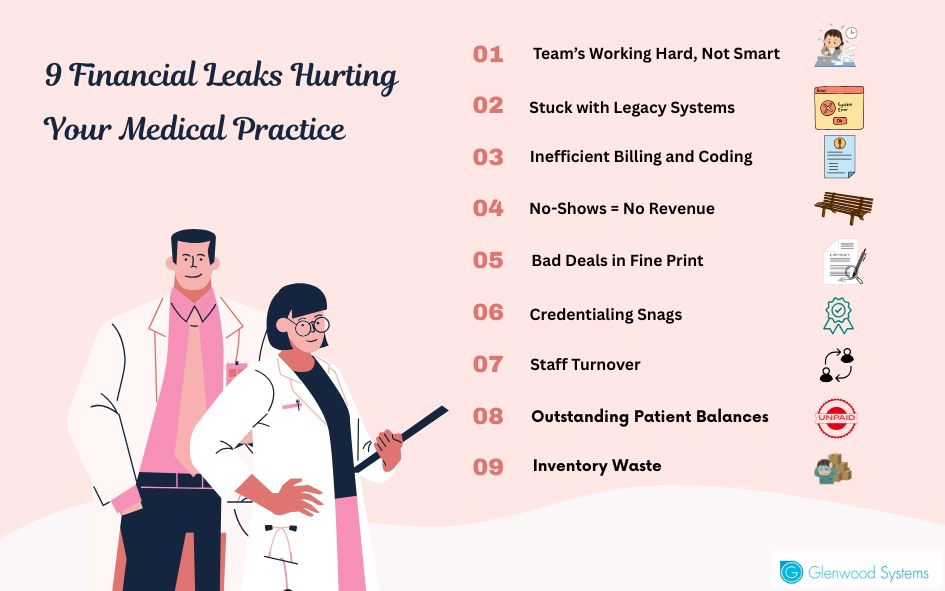
In this post, we’re breaking down 9 of the most common financial pitfalls that could be draining your medical practice, and actionable steps to fix them before they hit your margins too hard.
Money’s tight in healthcare, and practices are feeling it. Rising costs, tighter reimbursements, staffing gaps, and a steady stream of denials. It’s a lot.
And yet, according to a 2025 MGMA Stat poll, 56% of medical groups saw a revenue boost compared to 2024. How’d they turn things around when the odds were stacked against them?
It's simple. They found the silent leaks in their revenue cycle and sealed them. These weren’t massive overhauls, just strategic changes that added up: tightening up workflows, renegotiating contracts, updating tech, and collecting what they’d already earned.
Your practice can turn the corner, too. Seal these 9 common revenue leaks and let your cash flow reflect the hustle.
Busy doesn’t always mean productive. Is your team working hard, but falling short on efficiency? Are physicians handling prior authorizations? Are nurses spending time on scheduling or paperwork?
When highly skilled core team members are bogged down with administrative tasks, productivity dwindles. It drives up labor costs, slows down care delivery, and accelerates burnout.
Instead of hiring more staff, consider realigning responsibilities. Matching the right people to the right roles can unlock significant efficiency. Delegate routine admin work to support staff, or better yet, automate where possible. Freeing up clinicians to focus on patient care boosts workflow efficiency, improves clinical outcomes, patient satisfaction, and staff retention.
You may be delivering exceptional care and achieving strong clinical outcomes, but if you're relying on outdated technology, you're likely creating friction in the patient journey. And that friction directly impacts patient acquisition and retention.
Outdated EHRs, siloed systems, and manual workflows delay processes, such as scheduling, eligibility checks, documentation, and billing. These inefficiencies result in long wait times, slow collections, errors, and administrative headaches that frustrate staff and patients.
It’s time to reassess the ROI of your tech stack. If your legacy systems are holding back operational efficiency and scalability, they’re actively eroding your profit margins. Advanced, cloud-based EHR and RCM platforms streamline workflows from scheduling to collections, improve coding accuracy, and elevate the patient experience.
Moreover, with AI-powered automation, tasks such as documentation and payment collection can be nearly hands-free, which allows your team to optimize productivity and revenue capture. For example, Glenwood’s GlaceScribe leverages cutting-edge AI to deliver seamless transcription and scribe assistance, and GlacePhoneSmart automates patient payment reminders and resolves billing queries, helping your practice work smarter, not harder.
Billing and coding errors are more common than most practices realize, and even top-performing organizations aren’t immune. Minor issues, such as incorrect modifiers, outdated codes, or mismatched documentation, can quietly drain your revenue. Over time, these financial drains can compound into substantial losses.
Worse, consistent mistakes such as upcoding, unbundling, or misrepresenting services may be flagged as fraudulent behavior, exposing your practice to audits, penalties, and reputational damage.
Here's how to eliminate costly billing and coding mistakes:
Every missed appointment is lost revenue and, worse, wasted time that could’ve been filled. For example, if your clinic averages $200 per visit and even one patient doesn’t show up each day, that adds up to over $6,000 in missed revenue every month.
No-shows reduce provider productivity and eliminate opportunities to maximize revenue. If your practice is struggling with a high no-show rate, it’s time to uncover the root cause.
Is it a lack of reminders? Inconvenient appointment times? Difficulty rescheduling?
Identifying the “why” behind missed appointments is critical to fixing the issue. Here’s how you can address no-shows effectively:
Inadequate or outdated payer contracts are one of the most overlooked causes of revenue shortfalls in healthcare practices. Payer contracts can be a minefield, and if you’re not reading between the lines, you could be locking yourself into unfavorable or outdated contract terms, which means you're getting paid far less than your worth.
Regularly review your contracts for these red flags:
Make annual contract reviews a routine part of your business strategy to ensure terms keep pace with your services and expenses.
Credentialing may seem like a routine back-office task, but delays or errors in the process can impact your practice’s revenue and reputation. Two of the most common pitfalls are delays in initial credentialing and neglecting recredentialing requirements.
Providers who aren’t credentialed with a payer cannot claim reimbursements for their services. While credentialing for new providers is typically initiated upon hire, the manual, paper-heavy process often leads to delays that can extend for several months. Credentialing delays lock up revenue opportunities and stall operations.
Similarly, failing to recredential providers on time can disrupt reimbursement. For example, Medicaid typically requires recredentialing every five years. Missing these deadlines can result in claim denials, removal from payer networks, or temporary suspension of billing privileges.
Staff turnover is a critical challenge in the healthcare industry. According to the 2025 NSI National Healthcare Retention & RN Staffing Report, the average hospital turnover rate (2024) stands at 18.3%, while registered nurse (RN) turnover is 16.4%.
Employee churn can cost medical practices tens of thousands of dollars in recruitment, onboarding, and training, not to mention lost productivity, increased reliance on expensive temporary staffing, and strain on remaining employees.
To curb turnover and protect your margins, focus on:
Patients are increasingly seeking ways to save on healthcare costs, leading to a surge in enrollment in high-deductible, low-premium health plans. Unfortunately, the combination of rising out-of-pocket expenses and escalating overall healthcare costs has become a recipe for revenue loss for many practices.
According to Kaufman Hall’s National Hospital Flash Report, bad debt and charity per calendar day rose by 14% year-to-date in 2024, signaling just how serious this issue has become.
Inefficient patient collections can do more than dent your profit margins; they choke cash flow and impact everything from day-to-day operations to the quality of care you provide. Here’s how you can improve patient collections:
Inventory waste might not always be front and center, but it’s a quiet drain on revenue that adds up fast. It could be expired medications, unused medical supplies, or overstocked items collecting dust. Poor inventory management can eat into your margins and tie up valuable resources.
Overstocking to avoid supply shortages might seem smart, but it often leads to waste and unnecessary costs. Conversely, understocking can slow down care, frustrate patients, and trigger pricey, last-minute orders.
Modern tools are transforming how you manage your inventory. AI-powered inventory management replaces guesswork and outdated spreadsheets, providing real-time insights into what’s needed and when.
AI is transforming inventory management from a cost drain into a streamlined, waste-free process by:
Uncovering hidden revenue leaks can be startling and exhausting. Addressing them demands your time and energy; it’s one of those challenges you can’t ignore, yet rarely have the resources to tackle.
We feel your pain. Glenwood Systems has always been a champion for providers. Our automated billing workflows, AI-driven virtual assistants, integrated scheduling, and real-time reporting equip you with the clarity and control to eliminate costly errors, maximize efficiency, and keep your revenue cycle in peak health.
It’s time to seal the leaks and unlock every dollar your practice earns. Let’s connect and ignite your growth engine!
Schedule a Free Consultation!


