The conventional approach to growth in healthcare centers on squeezing more patients into already packed schedules to drive revenue. But in the pursuit of financial growth, many organizations overlook one critical element: physician well-being.
Practices that ignore physician burnout don't build a sustainable financial ecosystem; they create operational instability that eventually leads to turnover, inefficiencies, and revenue leakage.
The challenge is that many healthcare leaders still view burnout and revenue growth as competing priorities, assuming that reducing burnout will come at the cost of financial performance.
Fortunately, that mindset is changing. More organizations are recognizing that physician burnout and financial performance are deeply connected. By implementing strategies to reduce burnout and prioritize physician well-being, they’re also strengthening their financial performance.
The connection between burnout and revenue is far stronger than it appears. Organizations that understand this are building financially resilient practices.
When a practice is fighting an uphill battle to stay financially healthy, the instinct is often to increase patient volume and push operations harder within limited resources. Physicians and staff take on extra hours to reduce patient backlogs, speed up month-end close, or power through a difficult denial season.
It seems to work for a while. Queues shrink, revenue numbers improve, and you hit financial targets. But beneath that short-term momentum, another cost begins to build: burnout.
Burnout creates a hidden operational debt within the business model. It may help work move faster today, but it steadily increases the cost of sustaining that performance tomorrow.
As cognitive overload, administrative burden, and physical exhaustion build, physician productivity declines. Administrative tasks start piling up. Documentation quality slips. Denials increase. Revenue slows. And to compensate, practices often push teams even harder, increasing workloads, extending hours, and tightening schedules. And that only accelerates the cycle.
The pandemic pushed physician burnout to alarming levels, and its impact rippled across the healthcare system for years. Fortunately, the recent AMA’s National Physician Comparison Report is reassuring and points to gradual progress.
In 2025, only 41.9% of physicians reported experiencing burnout, down from 43.2% in 2024 and well below the peak (63%) recorded during the pandemic. The trend is moving in a positive direction, but the problem remains far from resolved. More than two in five physicians continue to struggle with burnout.
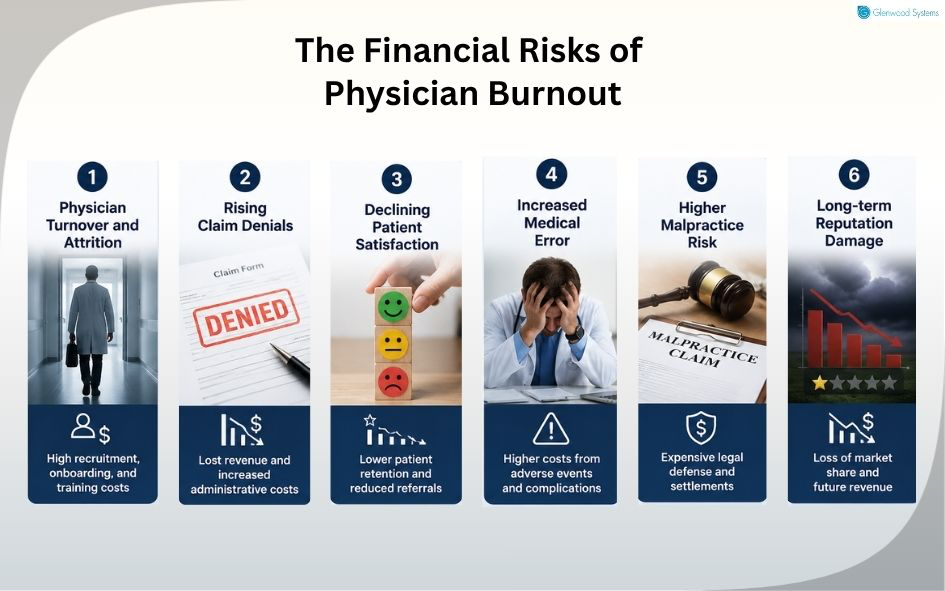
Physician burnout is not an individual well-being concern; it carries serious repercussions for medical practices. The impact shows up in the following ways:
The Industry Benchmark Report by AAPPR highlights that the physician turnover rate reached 7.8% in 2024, and burnout was a major contributing factor.
Burnout often creates a stressful, emotionally draining work environment where physicians no longer feel content in their profession. Over time, this dissatisfaction pushes physicians to leave the practice or exit the medical profession. And when a physician leaves, the financial impact on a practice is often substantial.
Practices are affected by both turnover and attrition. Turnover can cost practices anywhere from $500,000 to over $1 million per physician, including recruiting, onboarding, credentialing, temporary coverage, and the time it takes a new physician to reach full productivity.
Attrition, meanwhile, puts additional pressure on the remaining staff. Existing physicians and administrative teams must absorb heavier workloads, which reduces productivity, increases operational strain, and accelerates burnout. In both cases, burnout creates a costly cycle that drains revenue and weakens long-term operational stability.
When workload increases, efficiency is often compromised, especially when physicians are under constant pressure to meet high demand.
Burned-out physicians are more vulnerable to documentation gaps, coding inaccuracies, and delays in claim submission. Fatigue also affects focus, attention to detail, and coding accuracy, increasing the likelihood of claim denials. Denials leak revenue, disrupt cash flow, increase rework, and add unnecessary strain.
The physician-patient relationship is deeply personal. Trust, communication, and continuity of care are vital to the patient experience. But burned-out physicians often struggle with time constraints, patience, and emotional strength during patient interactions. Constant workload pressure and exhaustion can make consultations feel rushed, reduce engagement, and weaken the overall care experience. Over time, that directly affects patient satisfaction and retention.
The impact becomes even more significant when a physician leaves a practice. Patients who have built a long-term relationship with a physician may feel disconnected from their care or uncertain about continuing treatment within the same practice. This may lead to lower patient satisfaction scores, weaker patient loyalty, and even the loss of a portion of the established patient base.
Cognitive overload can reduce attention span, impair judgment, and interfere with clinical decision-making. When physicians operate under constant mental and emotional strain, the likelihood of oversight and errors increases.
In healthcare, even minor errors can compromise patient safety, affect treatment outcomes, and lead to non-compliance. Medical errors can also expose practices to regulatory scrutiny, financial penalties, legal risk, and reputational damage.
Long hours with packed patient schedules often lead to mental fatigue, which makes physicians vulnerable to errors and malpractice exposure. Legal defense costs, settlements, higher malpractice premiums, reputational damage, and administrative disruption place a significant financial burden on medical practices. In addition, ongoing legal concerns divert time, focus, and resources away from patient care and core business operations.
Burnout-related physician turnover also damages a practice’s reputation. Frequent physician exits weaken patient trust, disrupt continuity of care, and affect patient loyalty. As a result, practices may struggle with patient acquisition, staff recruitment, and referral relationships.
A medical practice's performance often mirrors its physicians' well-being.
Burnout is clearly evident across healthcare today, yet many practices still focus on easing its symptoms rather than addressing the root cause. Real change comes from addressing operational challenges alongside physician well-being.
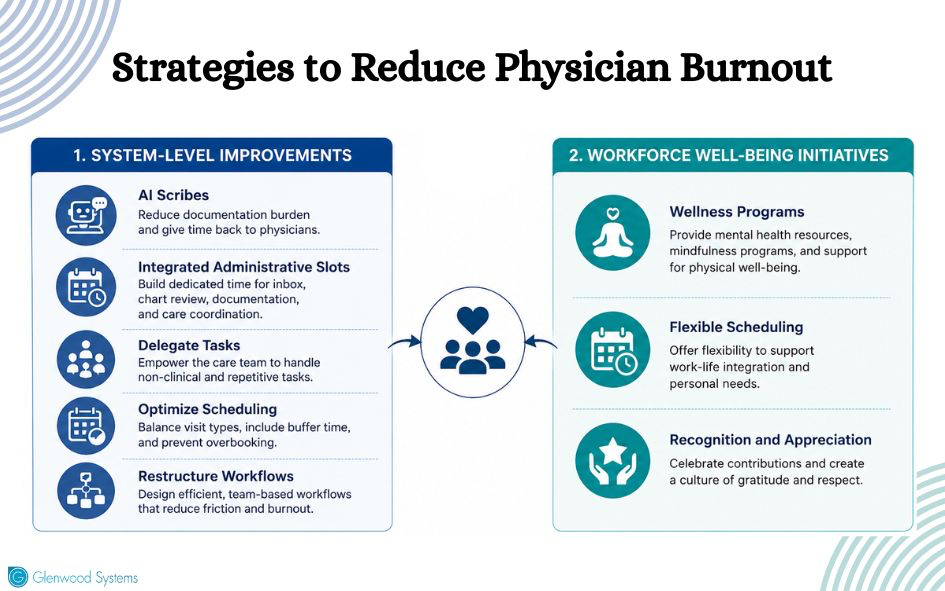
Mitigating physician burnout requires action on two fronts:
Physician burnout often begins with systems that demand too much while providing too little support. Redesigning workflows to reduce friction and administrative overload significantly improves physician well-being.
Consider implementing the following strategies:
AI scribes
Comprehensive documentation secures accurate reimbursement, but it also increases administrative burden. Many physicians spend nearly two additional hours each day completing documentation outside regular clinic hours.
AI scribes alleviate this burden. They capture patient conversations in real time and generate draft clinical notes that physicians can review before submitting the claim. Beyond saving time, AI scribes also ease cognitive overload and enable physicians to focus more on patient interactions rather than the screen.
A recent study found that AI scribes reduced physician burnout by 13%. Physicians also reported lower cognitive fatigue, improved workflow efficiency, and more meaningful patient engagement during consultations.
Integrated administrative slots
“Pajama time,” the hours physicians spend completing documentation and administrative tasks after work, is one of the biggest contributors to poor work-life balance and burnout. Reduce “pajama time” by building two to three dedicated slots into the daily schedule for administrative tasks such as chart reviews, inbox management, documentation, prescription renewals, and care coordination. These time blocks are often viewed as lost appointment opportunities, but in reality, they function as productivity enhancers.
Protected administrative slots reduce after-hours work, improve documentation accuracy, lower cognitive overload, and allow workflows to move more efficiently throughout the day.
Delegate tasks
Many responsibilities that consume physician time, such as prescription renewals, prior authorization follow-ups, inbox management, and administrative communication, do not always require physician involvement. Optimizing your workforce by delegating appropriate responsibilities reduces physician workload without compromising cere quality. Effective delegation also helps physicians focus on clinical decision-making and patient care while improving coordination, speedng administrative processing, and reducing barriers to care delivery.
Optimize scheduling
Repetitive and cognitively demanding schedules increase mental fatigue, reduce focus, and compromise the quality of care.
Avoid stacking consecutive high-intensity visits or scheduling patients with similar complex needs throughout the day. A more balanced scheduling approach that mixes visit types, includes recovery buffers, and distributes complex cases more evenly helps maintain clinical accuracy and supports consistent performance throughout the day.
Restructure workflows
In many cases, it’s the workflow design itself that limits efficiency. When too many administrative responsibilities are routed directly to physicians, the workload becomes unsustainable and contributes to burnout. Restructuring workflows to distribute workload more evenly improves operational efficiency and reduces unnecessary burden.
Message triaging is one example. An organized triage system helps prioritize urgent patient concerns and redirects routine or non-clinical messages to the appropriate team members. This reduces inbox overload, improves response times, and lets physicians focus on higher-value clinical tasks.
Similarly, enabling annual prescription renewals for chronic care medications prevents unnecessary visits, saves time, and eliminates repetitive administrative work.
Optimizing the system is only half the battle. Equally important is creating an environment where physicians feel supported, valued, and achieve consistent long-term performance.
Here are some best practices that promote physician well-being:
Wellness Programs
Invest in wellness programs that support stress management, self-care, and resilience training. Also, ensure counseling services and mental health resources are easily accessible and promote peer-support initiatives that help physicians feel connected rather than isolated.
Furthermore, develop a workplace culture where seeking support is normalized, burnout conversations are encouraged, and physician well-being is treated as an organizational priority rather than an individual responsibility.
Flexible Scheduling
Personal responsibilities and unexpected commitments are inevitable. Flexible scheduling options help physicians manage professional and personal demands more efficiently. Greater flexibility reduces stress, enhances job satisfaction, and promotes work-life balance.
Recognition and Appreciation
An overwhelming workload combined with a lack of recognition can gradually drain motivation and push physicians toward burnout and attrition. Physicians who consistently work under pressure without feeling acknowledged or supported may eventually lose job satisfaction and emotional connection to their work.
Actively recognize physician contributions in your practice, celebrate small wins, and foster a workplace culture where physicians feel valued.
Physician burnout is a silent revenue killer. The symptoms often go unnoticed until productivity declines, operational inefficiencies grow, and the revenue cycle begins to suffer.
The right systems help change the trajectory. Glenwood System's advanced practice and revenue cycle management tools, integrated with AI technology, simplify medical practice operations and reduce administrative workload. For example, GlaceEMR, integrated with GlaceScribe, captures patient conversations in real-time and automatically generates structured clinical notes, reducing after-hours charting, cognitive fatigue, and documentation burnout. Flexible scheduling options and integrated multi-channel appointment reminder systems help you optimize schedules and minimize no-shows.
Let's rediscover the satisfaction of practicing medicine. Schedule a demo now!
Schedule a Free Consultation!


