

“Keep seeing more patients, and profitability will follow.”
Sounds familiar? It’s a common assumption, and often, it’s where things start to go wrong.
A growing patient base does matter, yet it’s not the north star for profitability.
Many hesitate to think of medicine as a business. That hesitation is understandable. Patient care comes first, but a practice still needs financial stability to sustain that care.
And today’s healthcare environment only makes it harder. Rising operating costs, tightening reimbursements, increasing regulatory demands, and growing administrative burden are all putting pressure on margins.
To navigate this, practices need a more structured, multifaceted approach to profitability.
One way to make that approach actionable is to break it down into a simple framework: the 6 Rs of Practice Profitability. Each “R” highlights a critical area where margins are either built or lost, from how efficiently revenue is captured to how effectively costs and operations are managed.
The following sections break down these six levers and explain how they can help strengthen financial performance and build a more resilient practice.
The 6 Rs of Medical Practice Profitability
In any industry, economic shifts and regulatory pressures are part of the landscape; you don’t control them, but you respond as they unfold. In healthcare, that pressure is only increasing. Operating margins have declined by about 1.3% year over year, while expenses continue to rise, primarily due to higher supply and drug costs.
But here’s where the opportunity lies: much of what happens inside your practice is still within your control.
How your workflows are structured, how efficiently revenue is captured, how costs are managed, and how decisions are made day to day. These are the levers that ultimately shape your financial performance.
To bring clarity to this, the 6 Rs of Practice Profitability offer a structured approach to focus on what truly drives results. This framework breaks profitability into six core areas:
- Rationalization: Streamline operations and eliminate inefficiencies
- Revenue Cycle Efficiency: Ensure clean claims and accelerate payments
- Reimbursement Optimization: Reduce denials and renegotiate payer contracts
- Resource Management: Optimize overhead and staffing costs
- Retention & Acquisition: Strengthen the patient experience and long-term loyalty
- Revenue Enhancement: Expand high-margin services
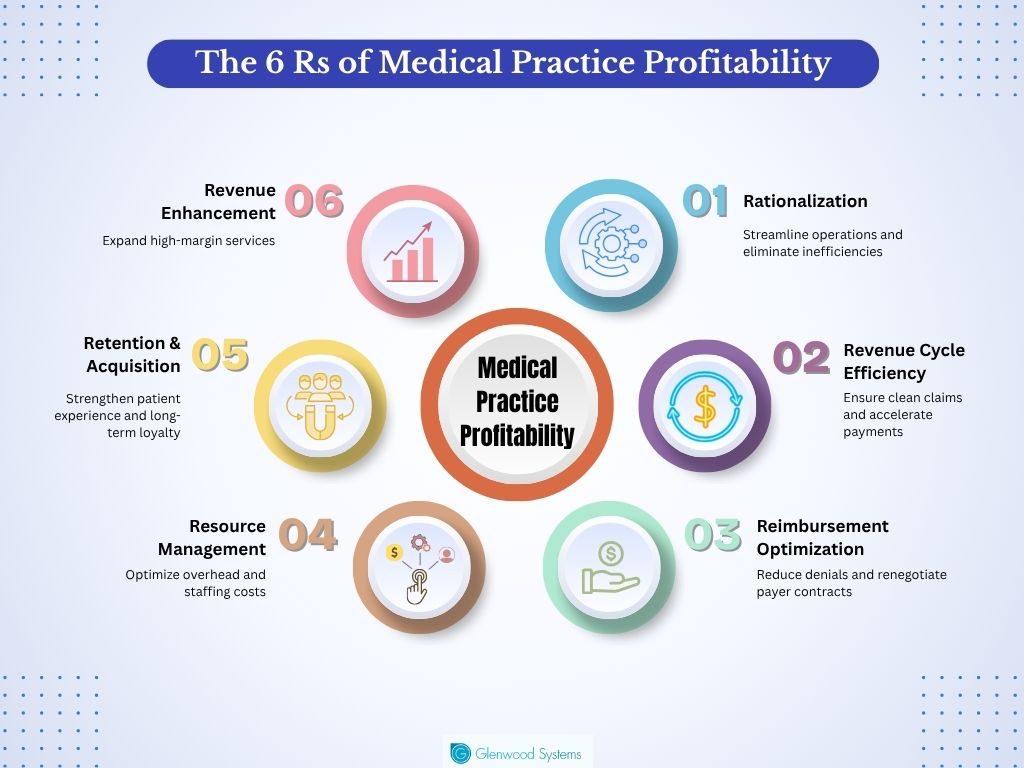
Each of these areas represents a practical opportunity to improve margins and strengthen financial performance.
In the sections ahead, we’ll take a closer look at each one and how it can help build a more resilient, profitable practice, even in a challenging environment.
1. Rationalization
Rationalization is the process of restructuring your practice to reduce revenue leakage and improve operational efficiency. It involves closely examining how your practice actually functions and removing anything that slows it down, duplicates effort, or adds cost without adding value.
Practice profitability is tied to productivity. When your practice runs efficiently, you get more value from the same resources.
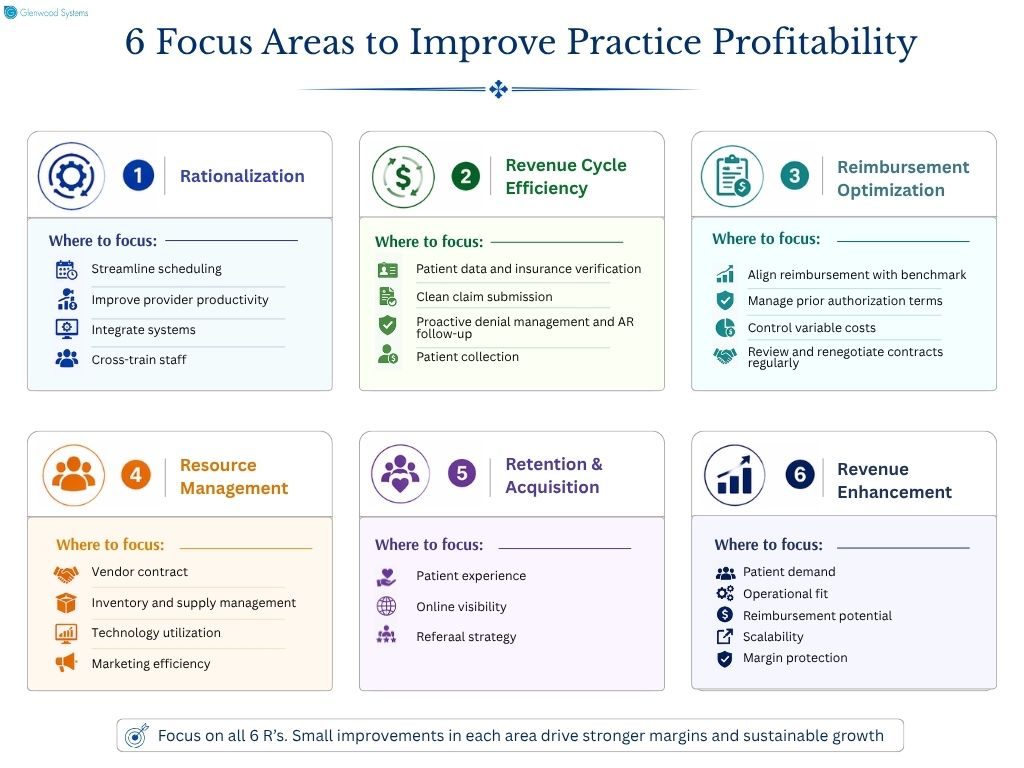
Where to focus:
Streamline scheduling
Are you still manually scheduling appointments?
Manual scheduling often creates gaps, overlaps, and underutilized provider time. Automating this process frees staff to focus more on patients at the front desk. It also improves patient access, reduces no-shows, and helps make better use of provider capacity.
Improve provider productivity
Documentation and administrative tasks consume a significant portion of providers’ time. While necessary, these tasks can limit productivity and contribute to burnout.
AI-assisted documentation and ambient listening tools, such as GlaceScribe, ease this burden, allowing providers to refocus on care without extending work hours. The result? Improved efficiency, increased patient capacity, and reduced burnout.
Integrate systems
Do your EHR, billing, and scheduling systems operate in silos?
Disconnected systems create redundancy. They require repeated data entry, which increases errors and slows processes. Staff often enter the same information multiple times, which negatively impacts productivity.
An integrated system enables smoother data flow, reduces administrative burden, and improves accuracy. It also provides better visibility into practice performance.
Cross-train staff
Staff shortages and turnover continue to challenge many practices. One effective way to address this is cross-training.
Cross-trained staff can handle multiple roles, ensuring continuity and improving workforce flexibility, allowing your practice to maintain efficiency even during staffing gaps or unexpected disruptions.
2. Revenue Cycle Efficiency
Once your operations are optimized, the next step is to strengthen your revenue cycle.
Your schedule may be full, but your margins can still tell a different story. More often than not, the gap comes down to how efficiently revenue is captured and collected.
Revenue cycle efficiency is about ensuring the money you earn is collected with minimal friction.
Where to focus:
Patient Data and Insurance Verification
Front-end inefficiency is the leading cause of claim denials. Automating eligibility checks improves accuracy, reduces rework, and prevents denials.
Clean claim submission
Inadequate documentation and coding errors are another common cause of revenue loss from rejections and denials. AI and automation tools, such as GlaceRCM and GlaceScribe, close documentation gaps, improve coding accuracy, and increase first-pass acceptance rates. A higher clean claim rate implies maximum revenue capture.
Proactive Denial management and AR follow-ups
Unpaid claims don’t resolve themselves. Without a structured follow-up process, they continue to age and strain cash flow. A proactive AR strategy that prioritizes high-value accounts helps reduce days in AR and ensures consistent cash flow.
Patient collections
Rising patient responsibility has made collections a critical driver of practice profitability. That’s why front-desk collections matter more than ever. Collecting at the point of care helps secure payments early, reduces follow-up workload, and minimizes bad debt.
Making it easy for patients to pay also plays a major role. Offering multiple payment options, such as digital payments, card-on-file, or flexible plans, significantly improves collection rates.
3. Reimbursement Optimization
You might have your processes running efficiently, but unfavorable payer terms still erode revenue.
Payer contracts that once worked well can start working against you. Reimbursement rates may not keep pace with rising costs, terms may fall below market benchmarks, and increasing prior authorization requirements can delay or limit payments. Over time, this directly erodes your margins.
Regular evaluation and renegotiation help ensure your agreements reflect your current cost structure, services, and market realities.
Where to focus:
- Align reimbursements with benchmarks: Compare payer rates to industry benchmarks and across contracts. Identify underperforming payers and prioritize them for renegotiation.
- Manage prior authorization terms: Negotiate terms that minimize administrative burden and improve turnaround times.
- Control variable costs: Monitor rising supply and operational costs and keep them in line with reimbursement levels. When payer rates remain flat, controlling variable costs helps protect margins.
- Review and renegotiate contracts regularly: Periodically review payer contracts. Ongoing evaluation helps identify unfavorable trends early and strengthens your position during negotiations.
4. Resource Management
Operating costs in medical practices have risen sharply, by about 11% in 2025 alone, and with ongoing economic pressures, they show no signs of slowing. This makes resource management a critical lever for protecting margins.
Resource management means using your people, space, supplies, and technology as cost-effectively as possible. However, not every cost affects your practice the same way. What drives overhead in one practice may not in another. That’s why it’s important to regularly analyze your cost structure and make targeted, strategic decisions rather than blanket cuts.
Where to focus:
Vendor contracts
Outdated vendor agreements that no longer reflect current economic realities can create hidden revenue leaks and unnecessary expenses. Costs may rise over time, while contract terms remain unchanged. Review your vendor contracts regularly. Renegotiate terms or consolidate vendors to reduce expenses without disrupting operations.
Inventory and supply management
Inefficient inventory practices often lead to overstocking, waste, or last-minute purchases at higher costs, all of which put pressure on your margins.
To manage inventory more effectively:
- Track usage and reduce waste: Monitor consumption to avoid overordering and minimize losses.
- Standardize purchasing: Use consistent processes to improve cost control and predictability.
- Negotiate bulk pricing: Leverage volume to secure better rates on high-use items.
- Join a GPO: Access pre-negotiated pricing and discounts.
- Apply FIFO/FEFO: Use older or earlier-expiring items first to reduce waste.
Technology utilization
Many practices invest in multiple tools that remain underutilized. Before adding new systems, assess whether you’re fully leveraging what you already have. Consolidating platforms also helps reduce costs and improve operational efficiency.
Marketing efficiency
Effective marketing is crucial to driving profitability, so these expenses warrant close management. The best way to optimize marketing spend is to track the return on investment (ROI) of your campaigns. Focus on channels that consistently attract high-value patients, and scale back those that don’t deliver results.
5. Retention & Acquisition
Retention and acquisition are critical drivers of your practice’s revenue.
Retention keeps your existing patients coming back, generating steady revenue without additional marketing spend. Acquisition brings in new patients who align with your services, improving case mix and maximizing the return on your marketing efforts.
Interestingly, both metrics are influenced by the patient experience.
A smooth patient journey, where patients feel heard, respected, and supported, builds trust. And trust drives behavior. Patients are more likely to return, refer others, and complete their care.
Where to focus:
- Patient experience: Streamline the patient journey, from scheduling to billing. Easy booking, clear communication, and flexible payments improve satisfaction and retention. Reminders and follow-ups also keep patients engaged and reduce no-shows.
- Online visibility: Make it easy for patients to find and choose your practice. Update your profile regularly with accurate information, services, and photos of your practice to make a strong first impression.
- Referral strategy: Encourage patients to share their experiences and leave reviews. Positive reviews build trust and attract new patients.
6. Revenue Enhancement
Improving efficiency strengthens margins, and expansion drives growth.
Revenue enhancement focuses on introducing high-margin services that align with your current patient base, clinical capabilities, and workflows without significantly increasing operational complexity.
For example, if you run a primary care practice, you could introduce chronic care management, annual wellness visits, in-office point-of-care testing, or preventive health programs. These services can increase revenue without requiring a major expansion of staff, space, or infrastructure.
Note: Avoid adding services that raise overhead faster than revenue.
Select a niche or service line that integrates smoothly into your current system and creates new growth opportunities. In other words, the best revenue-enhancement ideas reuse what you already have.
Where to focus:
- Patient demand: Identify the services your patients need.
- Operational fit: Select services that align with your current staff and workflow.
- Reimbursement potential: Prioritize services with strong reimbursement and low delivery costs.
- Scalability: Select offerings that can scale without major expense.
- Margin protection: Avoid services that increase complexity without improving profitability.
Rebuilding Stronger Margins
Starting a private practice is challenging, but sustaining and thriving in it requires more than effort. It takes the right systems, strategy, and adaptability.
Profitability doesn’t come from fixing just one system or workflow. Small gaps across operations, billing, and revenue management can add up and pressure on margins. Addressing them requires careful analysis and a well-rounded, strategic approach.
The good news is you don’t have to manage it all alone. Glenwood Systems streamlines your revenue cycle and optimizes practice operations, ensuring everything works together efficiently. With an integrated suite of practice management and revenue cycle tools, Glenwood closes operational gaps, improves efficiency, and supports more consistent financial performance.
Inefficiencies shouldn’t define your margins.
Let’s connect to build a more efficient and profitable practice.